

Trump voters heavily favour 20 per cent tariff on all countries, three-quarters of Harris voters say no
October 31, 2024 – The result of the 2024 presidential election will have myriad consequences for Americans, but these impacts extend across borders as well. One of the biggest potential policy implications would be the implementation of tariffs on goods entering the United States under a second term of Donald Trump.
New data from Angus Reid finds Trump and Vice President Kamala Harris supporters offering divergent views of this protectionism, which economists predict could have compounding and disastrous outcomes for the U.S. and the rest of the globe.
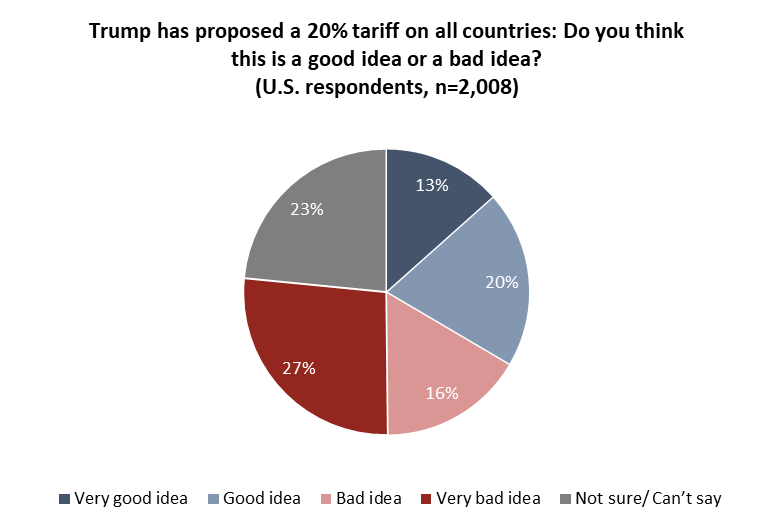
Asked if the United States should universally apply a 20 per cent tariff to all countries, something Trump has publicly offered, one-in-three (33%) Americans say this is a good idea, while 43 per cent say it’s a bad one, and 23 per cent are unsure. Two-thirds of Trump voters (66%) say this is a good policy, compared to one-in-10 (11%) Harris voters.
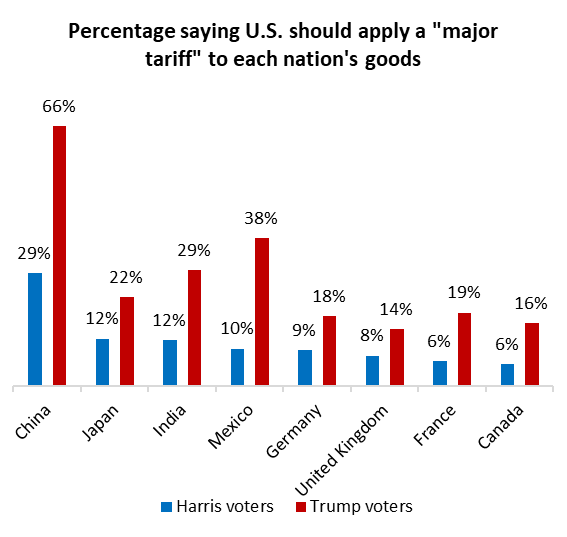
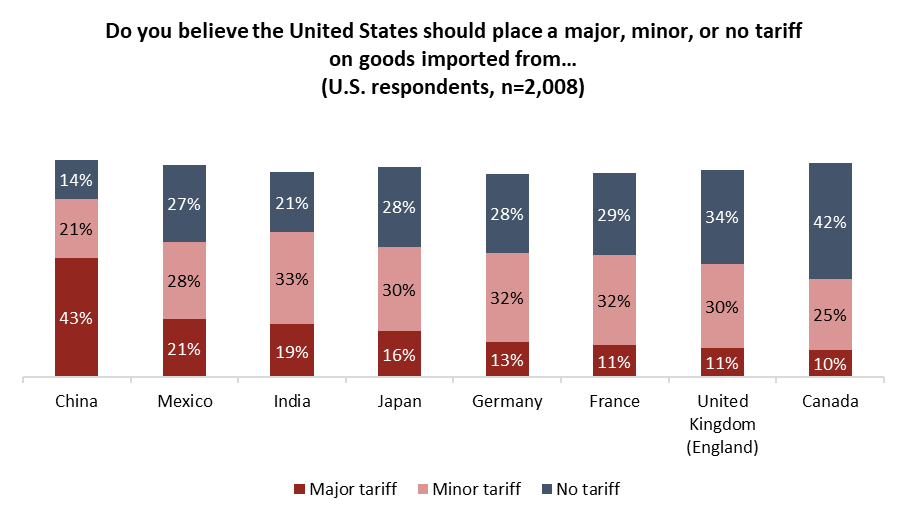
Asked about some of America’s allies and international competitors, it is clear that many feel not all countries should be treated equally. Consider that a “major tariff” on Chinese goods draws support from 43 per cent, while the same proposal for Mexico drops to 21 per cent, and for Canada drops to 10 per cent. Even Trump voters delineate more carefully when it comes to Canada, considered by many to be the nation’s closest ally. Fewer than one-in-five (16%) among this group would hit Canada with a major tariff on goods, compared to 28 per cent for Mexico and 66 per cent for China.
About ARI
The Angus Reid Institute (ARI) was founded in October 2014 by pollster and sociologist, Dr. Angus Reid. ARI is a national, not-for-profit, non-partisan public opinion research foundation established to advance education by commissioning, conducting and disseminating to the public accessible and impartial statistical data, research and policy analysis on economics, political science, philanthropy, public administration, domestic and international affairs and other socio-economic issues of importance to Canada and its world.
INDEX
-
Major, minor, or no tariff on each nation?
-
Partisan perspectives
-
What about Canada?
-
Views on a universal 20 per cent tariff
Major, minor, or no tariff on each nation?
While there is evidently a significant amount of anxiety in the United States with less than a week until election day, the rest of the world is feeling some stress, too. Republican candidate and former president Donald Trump has talked extensively about increasing the number and intensity of tariffs on foreign nations if elected. A tariff is a form of tax that is imposed on imports from another country. It is notable that in broadly accepted economic theory, the tariff is paid for by consumers in the home nation. Tariffs are thought to protect domestic industries, but often at the cost of efficiency. Critics have noted that while Trump and his economic advisors have stated that they will use tariffs to reduce America’s trade deficit, it actually grew in his first term by 25 per cent after his administration imposed tariffs on goods including steel and aluminum.
Americans were asked about this concept, and whether they supported an undefined “major” tariff, “minor” tariff, or no tariff at all on each of eight different nations, in order to gauge their appetite for protectionist policies. With respect to China, the largest supplier of goods to the American market at 16.5 per cent in 2022, tariffs are popular. Two-in-five (43%) would target China with a major tariff, while one-in-five would introduce a smaller tax. All other nations fall well below this level:
Partisan perspectives
The desire for protectionist policy is, however, much more of a defining feature among Trump voters than those supporting Harris. Two-thirds of the former would apply a major tariff to China compared to three-in-10 among the latter. Trump supporters are more likely to support major tariffs on all nations, though China and Mexico are elevated choices:
What about Canada?
Canada and the United States have historically been considered among the closest of allies, but this relationship soured under Trump during his first term. He and Prime Minister Justin Trudeau were at odds periodically, including during the negotiation of the Canada-United States-Mexico Agreement, the replacement trade agreement for NAFTA. Trump has said he would renegotiate the agreement again if he wins on Tuesday. Trudeau criticized Trump’s tariffs in 2018, with the latter responding that “that’s going to cost a lot of money for the people of Canada”.
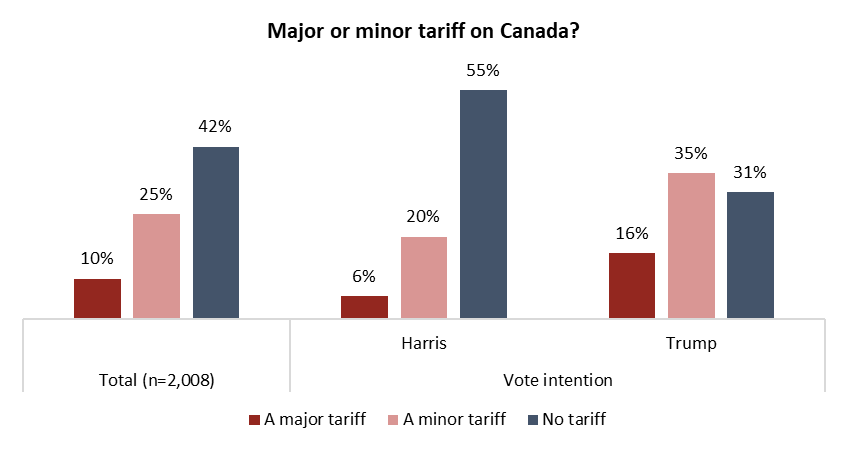
Trump’s voters are more hard line on tariffs for Canadian goods than Harris voters, though larger numbers lean toward a minor uniform tariff (35%) or no tariff at all (31%) than a major one (16%).
Views on a universal 20 per cent tariff
Harris has called the Trump tariff plan a “sales tax on the American people” and has countered by saying she would increase government revenue by increasing the corporate tax rate from 21 to 28 per cent. Notably, however, the Biden-Harris administration did maintain previous Trump-era tariffs, which were far more limited in scope.
Independent estimates are that a 10 per cent universal levy would cost each American household an average of $2,000 a year, while the Harris campaign has stated that a 20 per cent rate, which Trump has publicly supported, would cost the average American household $3,900 a year.
Americans are more likely to feel this 20 per cent tariff is a bad idea than a good one, with the largest group (27%) say it’s a very bad concept:
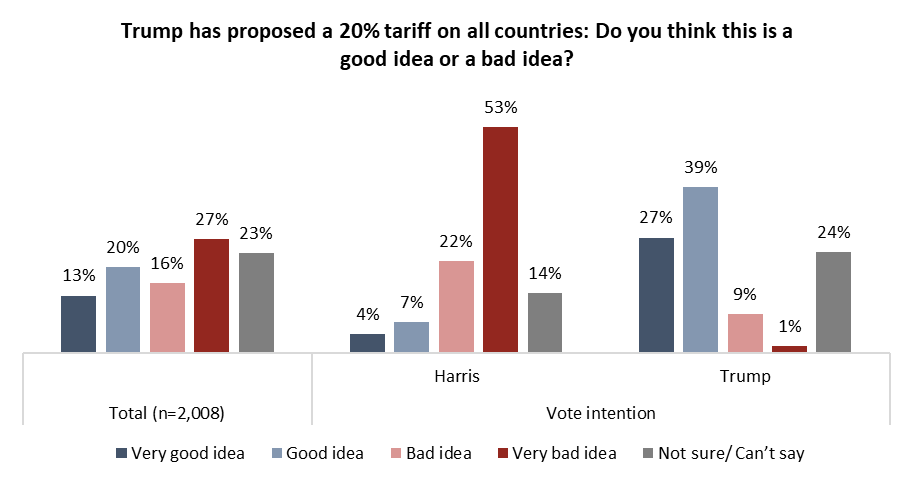
As might be expected, Trump voters are much more likely to view this plan favourably. Two-thirds (66%) say it’s a good idea while just 10 per cent say it’s a bad one. Conversely, one-in-ten Harris voters feel it is a good idea (11%) and three-quarters are against it (75%):
Survey Methodology:
The Angus Reid Institute conducted an online survey from Oct. 23-27, 2024 among a representative randomized sample of 2,008 American adults who are members of Angus Reid Forum USA. For comparison purposes only, a probability sample of this size would carry a margin of error of +/- 2 percentage points, 19 times out of 20. Discrepancies in or between totals are due to rounding. The survey was self-commissioned and paid for by ARI.
For detailed results by age, gender, region, education, and other demographics, click here.
For the full release including methodology, click here.
For the questionnaire, click here.
Image – ID 114144310 |© Wissanu Sirapat | Dreamstime.com
Shachi Kurl, President: 604.908.1693 shachi.kurl@angusreid.us @shachikurl
Dave Korzinski, Research Director: 250.899.0821 dave.korzinski@angusreid.us