
October 27, 2015 – Monday night saw Republican congressional leaders and President Obama reach a tentative budget deal that would allow for a raise of the federal debt ceiling above its current level of $18.1 trillion, which assures the country will not default on its federal debt. The deal was bargained on the basis of spending cuts to Medicare and Social Security disability benefits, though a modest one per cent increase in the federal budget will be included over the next two years.
Americans are largely non-committal when asked whether this is the right course of action. In a recent AP-GFK poll, the largest portion of 1,027 Americans asked said they neither support nor oppose the raising of the debt ceiling to avoid defaulting on U.S. government debt (44%). Just under one-quarter (24%) said the move is justified, while 29 per cent disagree.
As for shutting down the government, there are differing opinions on when this is appropriate. Respondents were asked the question “Is each of the following goals so important that it would be worth shutting down the government to achieve it, or not?” The most supported option of those presented was in fact “reducing government spending”, with more than half (56%) of respondents saying a shutdown is justified if this is the goal.
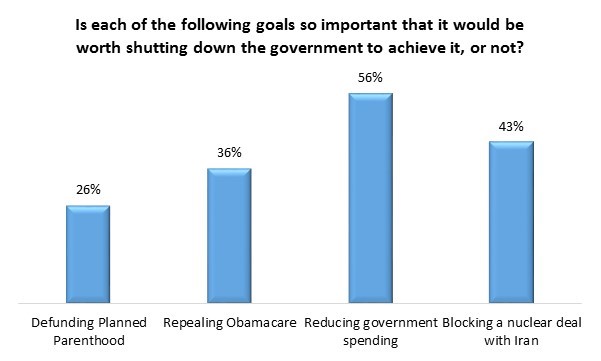
This has been precisely the strategy taken by Republicans over the last 5 years when the debt ceiling deadline has come about. It should be noted that when the government was shut down in 2013 over this issue, 81 per cent of Americans disapproved of the maneuver, and 71 per cent strongly disapproved.
Methodology: Online responses from 1,027 American adults. Data is weighted for sex, education, and race. Margin of error is reported as +/- 3.3%