
Non-MAGA GOP voters break with Trump on key issues; ½ of Democrats unhappy with their own party
January 22, 2026 – The impacts of U.S. President Donald Trump’s first year of his current term appear to be creating serious fissures between MAGA and non-MAGA Republican voters.
New data from Angus Reid USA finds those who align themselves with the MAGA movement and those who don’t holding widely divergent on views of Trump and his exploits.
While the MAGA-aligned find little to criticize Trump over and Democrats find little to praise him for, Republicans who eschew the MAGA label appear to be experiencing both elation and disappointment. Reducing illegal immigration at the southern border, removing Nicolas Maduro as President of Venezuela, and ICE enforcement actions are each significantly praised by Republicans of all kinds.
But two core, foundational issues are frustrating non-MAGA Republicans: health care and the cost of living.
Asked if they’re please or upset about both during the first year of the Trump presidency, non-MAGA Republicans score a minus 30 on the cost of living (24% pleased, 54% upset) and a minus 20 on health care (22% pleased, 43% upset). These are complimented by negative scores on the handling of the Epstein files (net score of -26) and the discussion of plans to annex Greenland (-23). Perhaps the largest divide of all between these two groups of Republicans, however, is in the role of the executive. MAGA Republicans are overwhelmingly supportive of Trump’s propensity for bypassing congress in many of his dealings (+69), whether with Venezuela, tariffs, or other actions. For non-MAGA Republican, this is a source of more consternation (+2).
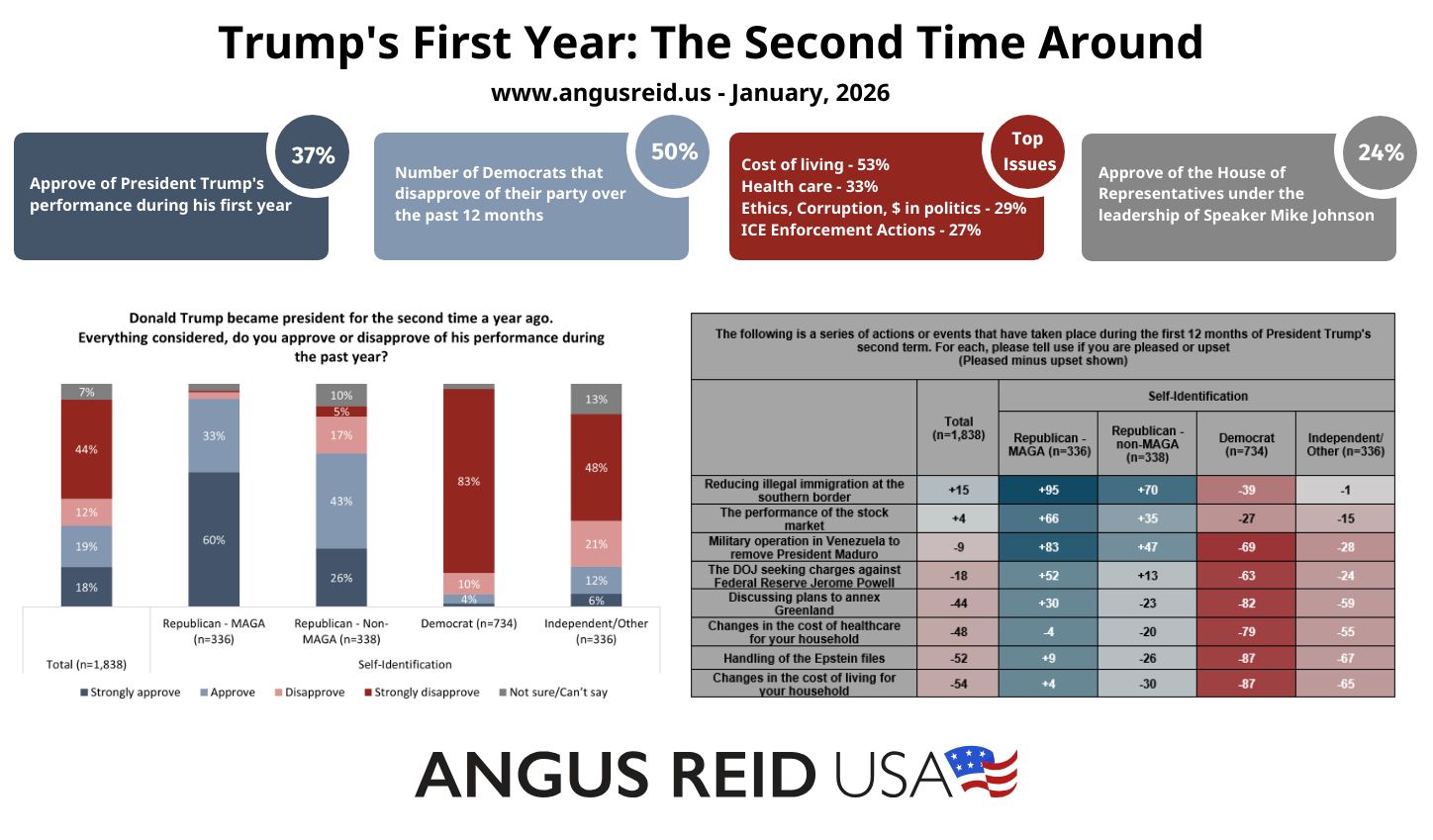
As he heads into his second year, 37 percent of Americans say they approve of the first one, while 56 percent disapprove.
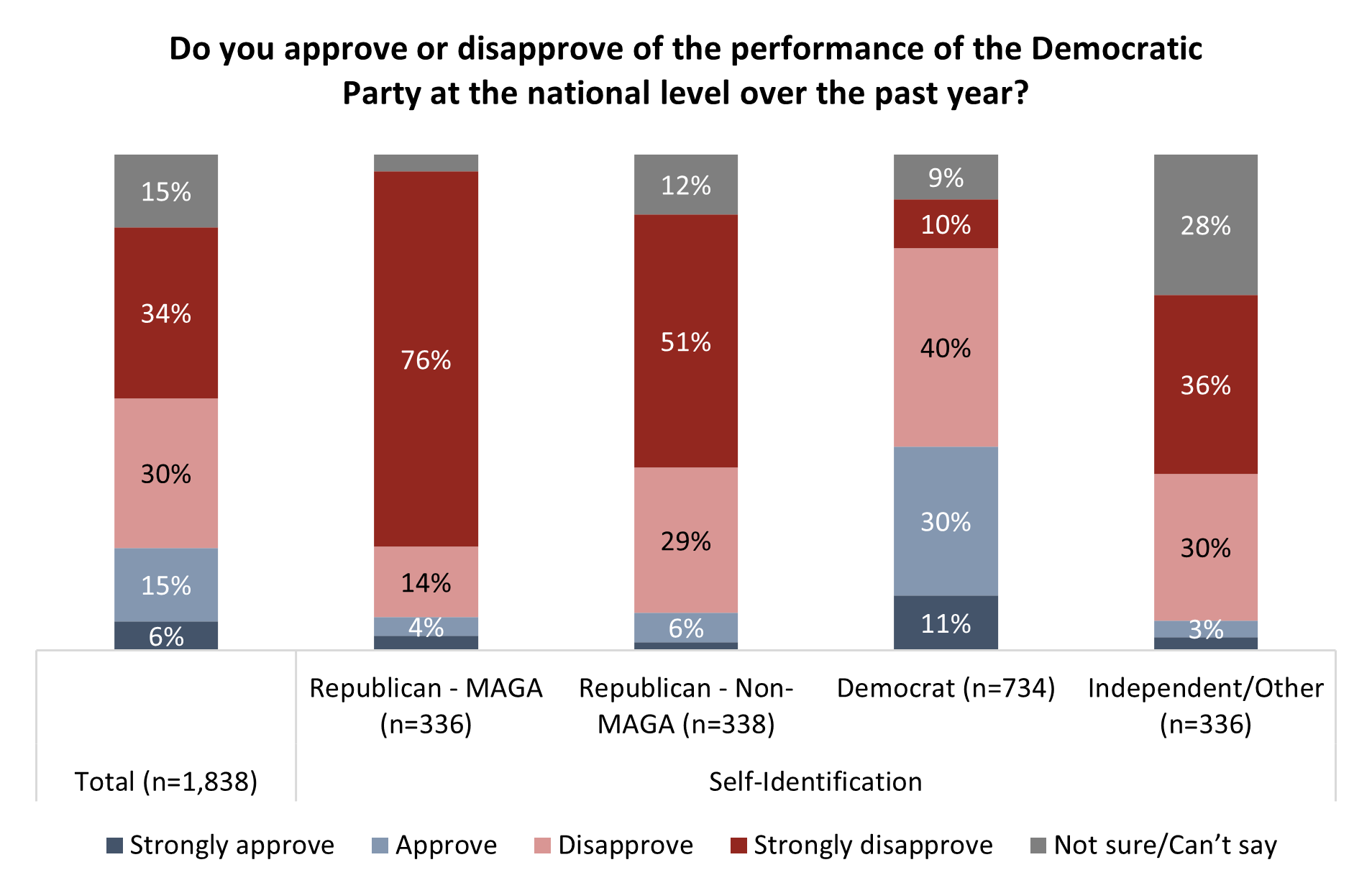
Despite criticism of Trump, just 21 percent approve of the job done by the Democrats over the past 12 months, while 64 percent disapprove. Among Democrats, more disapprove (50%) than approve (41%).
More Key Findings:
- Trump’s approval: MAGA Republicans – 93%, non-MAGA Republicans – 69%, Democrats – 6%, Independents/Other – 18%
- Two issues of the 17 receive more praise than criticism – reducing illegal immigration at the southern border and the performance of the stock market
- The most criticized issues are discussions of annexing Greenland, handling of the cost of living, handling of health care, and the Epstein files
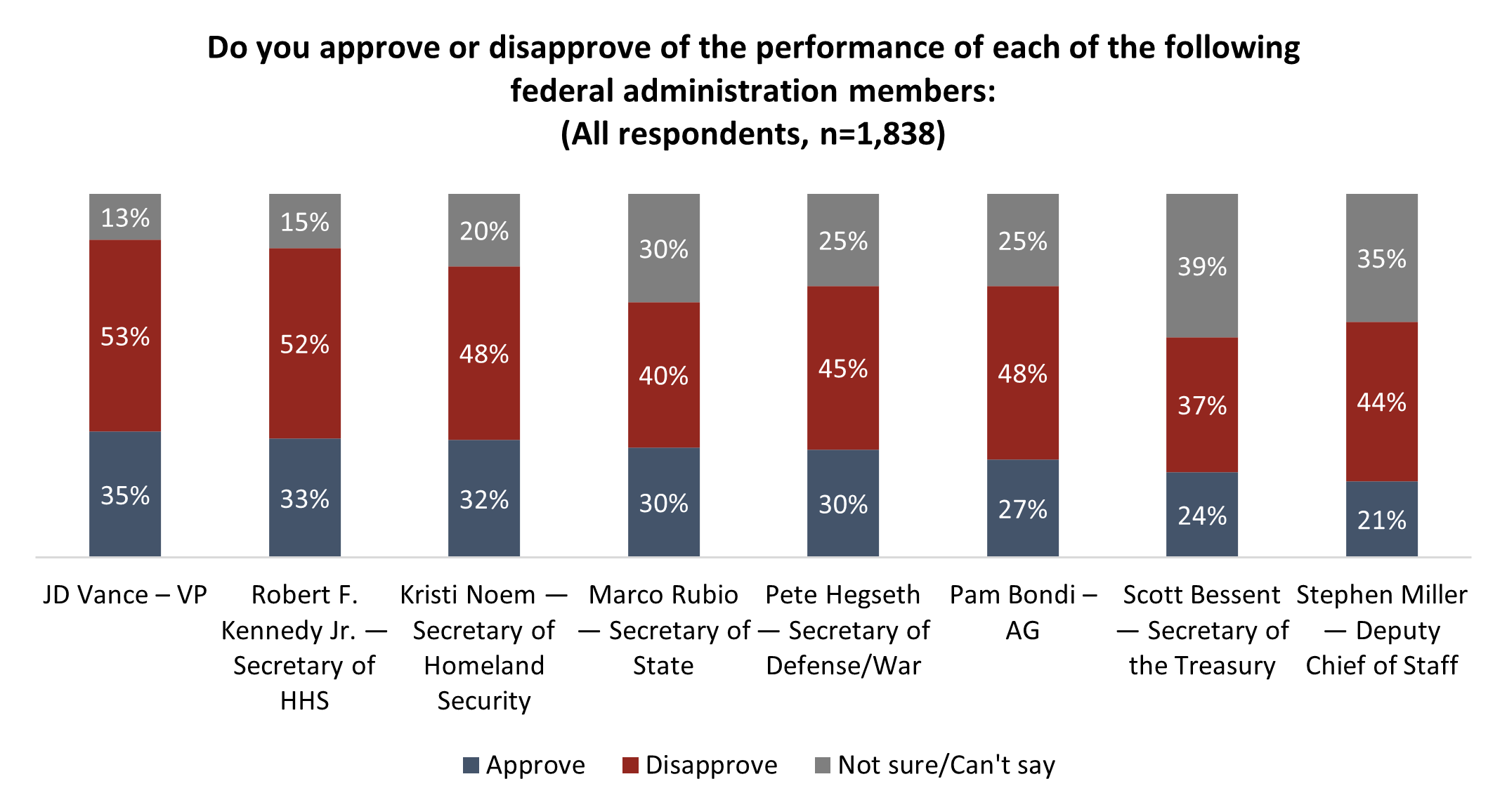
- Vice President JD Vance garners the highest level of approval among major administration members, at 35 percent. Deputy Chief of Staff Stephen Miller fares worst at 21 percent
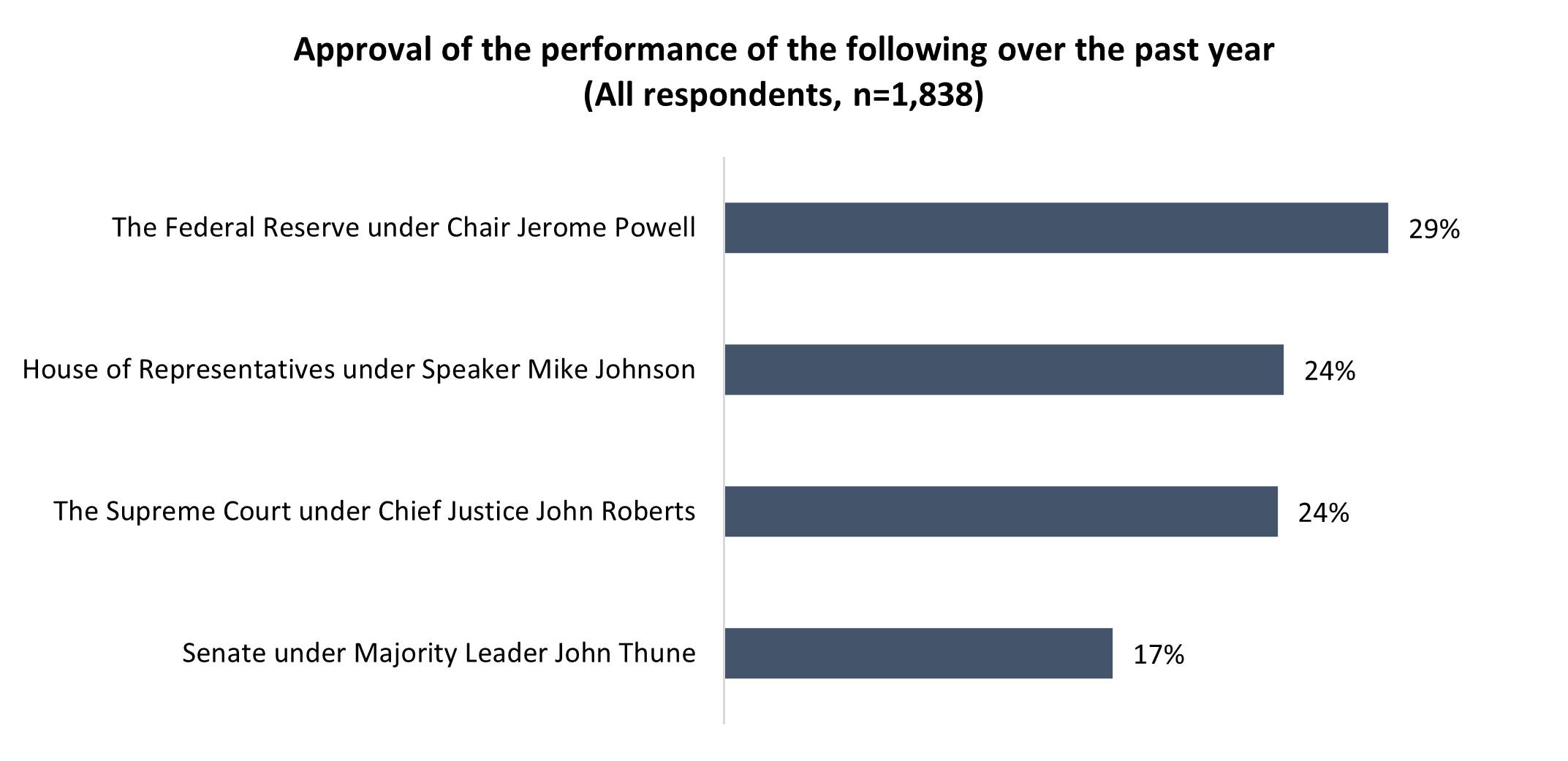
- The Senate (17%), the House of Representatives (22%) and the Supreme Court (24%) all have poor approval levels
- The “cost of living and inflation” looms as the top issue facing the country. Half of Americans (53%) choose this as a top concern, 20-points ahead of the next most chosen issue, health care (33%).
INDEX
-
Trump approval after one year – a fissure between MAGA and non-MAGA Republicans
-
Major policies and events from the first year
-
Current priorities for the country
-
Appraising Trump administration figures
-
Democrats criticized, even by many Democrats
-
House and Senate garner poor approval
Trump approval after one year – a fissure between MAGA and non-MAGA Republicans
The return of U.S. President Donald Trump to the Oval Office set off a whirlwind of policy changes with global implications. It also has resulted in a drastic change in the day-to-day lives of Americans compared to the previous four years under Democrat President Joe Biden.
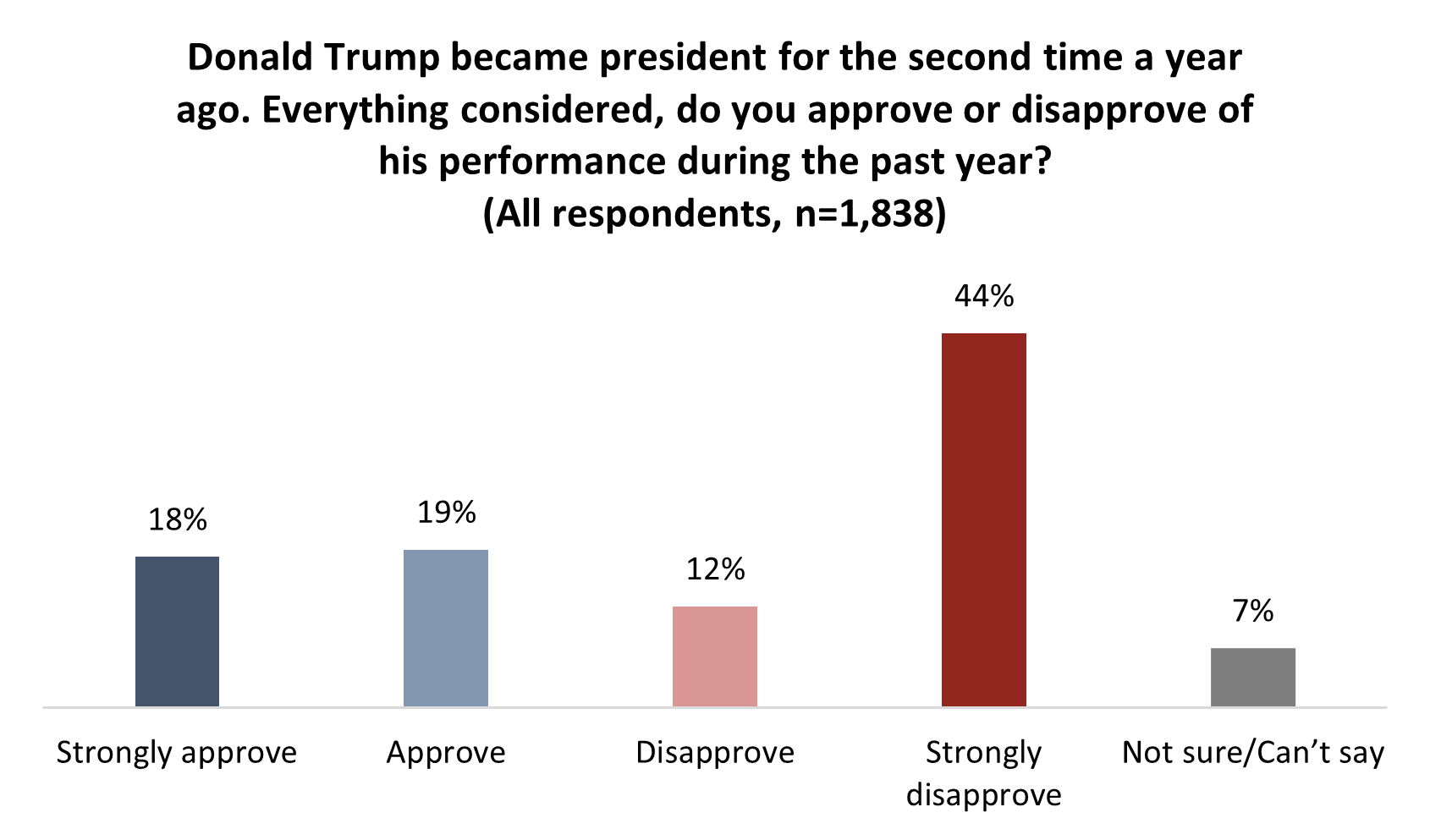
Americans offer more criticism than praise for Trump after the first year of his second term. A majority (56%) say they disapprove of his performance over the past 365 days, while fewer than two-in-five (37%) say they approve so far:
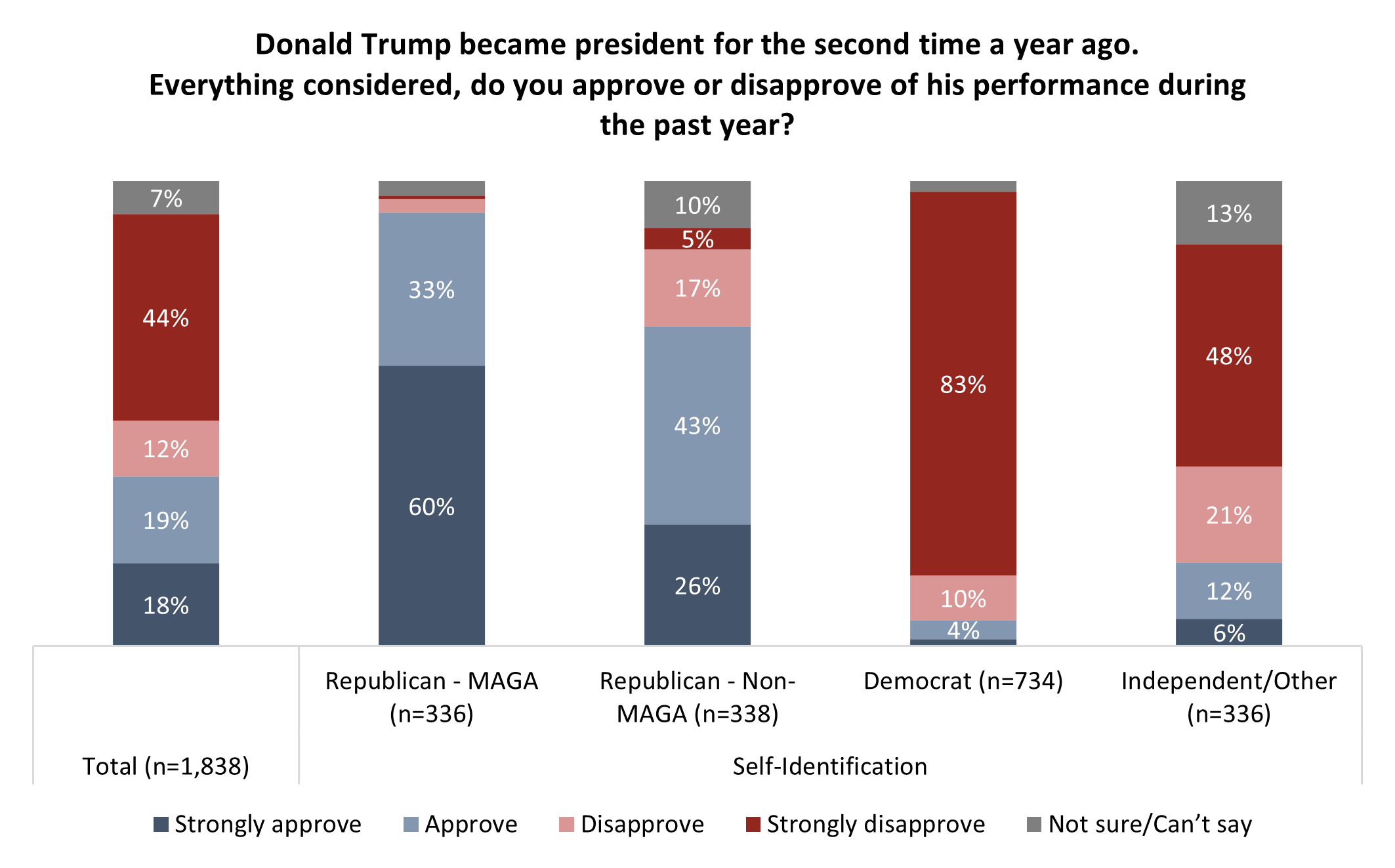
Assessments of Trump vary by respondents’ politics, as one might expect. Republicans offer more approval, while Democrats offer near unanimous condemnation. However, even in the Republican camp there is variance in opinion. Republicans who self-identify as MAGA nearly all (93%) approve of Trump’s performance over the past year, including three-in-five (60%) who strongly do so. Republicans who do not don the MAGA label offer more muted praise. A majority (69%) in this group still approve, but there are fewer who do so strongly (26%). And within non-MAGA Republicans, there is a much larger group of one-in-five (22%) who believe Trump’s performance has been negative:
 Major policies and events from the first year
The missives, military strikes, executive orders, policy changes on social media, and transformations have been whiplash-inducing during this first year of Trump’s second term. Angus Reid compiled a lengthy but no means comprehensive list of some of the most significant developments during the last year to assess Americans’ reaction to the events that have unfolded.
Trump’s efforts to reduce illegal immigration at the United States’ border with Mexico is the most popular of those included in the survey, with half (49%) saying they are pleased with that focus and one-third (34%) upset.
The effect of Trump’s presidency on the stock market also receives more positive reactions than negatives ones. After a steep fall in April in the wake of “Liberation Day” tariffs, the S&P500 has rallied to new highs, up more than 16 percent from the end of 2024.
But the stock market and efforts on the U.S. southern border are the only two policies and actions in the past 12 months that Americans are more pleased than upset at. Trump has been quick to take credit for the stock market’s gains, though it is worth noting that despite considerable volatility, the markets have been cruising upward for years, under both presidents.
A majority of Americans say they are upset with the actions of ICE across the country (58%), the swath of tariffs (57%), the DOGE layoffs (56%), changes to childhood vaccine recommendations (53%), withholding federal funding for universities (56%), pardons for Jan. 6 convictions (58%), concentrating power in the White House (57%), handling of the ongoing Russian invasion of Ukraine (54%), the handling of the Epstein files (65%) and the recent focus on annexation of Greenland (59%).
But perhaps most key as American voters return to the polls for midterm elections this fall, strong majorities of Americans express discontent of the Trump 2.0 term’s effect on their personal finances. Seven-in-ten (70%) are upset at the negative impact to their household’s cost of living; three-in-five (62%) are displeased with the changes to their household’s health care costs:
 A political lens sharpens the view of the American divide over Trump’s actions and policies in this second term. Self-identified MAGA Republicans are more pleased than upset at most of the list included in this survey but are divided over those key issues of household costs and Trump’s handling of the Epstein files. Non-MAGA Republicans also express more criticism on those issues, as well as the conversation of annexing Greenland. This group also is divided over the Jan. 6 pardons and the concentration of executive power.
Across the board, Democrats are more upset than pleased at the actions presented to them. Independents, too, offer more jeers than cheers, but are notably split on Trump’s effects on illegal immigration at the Mexico border: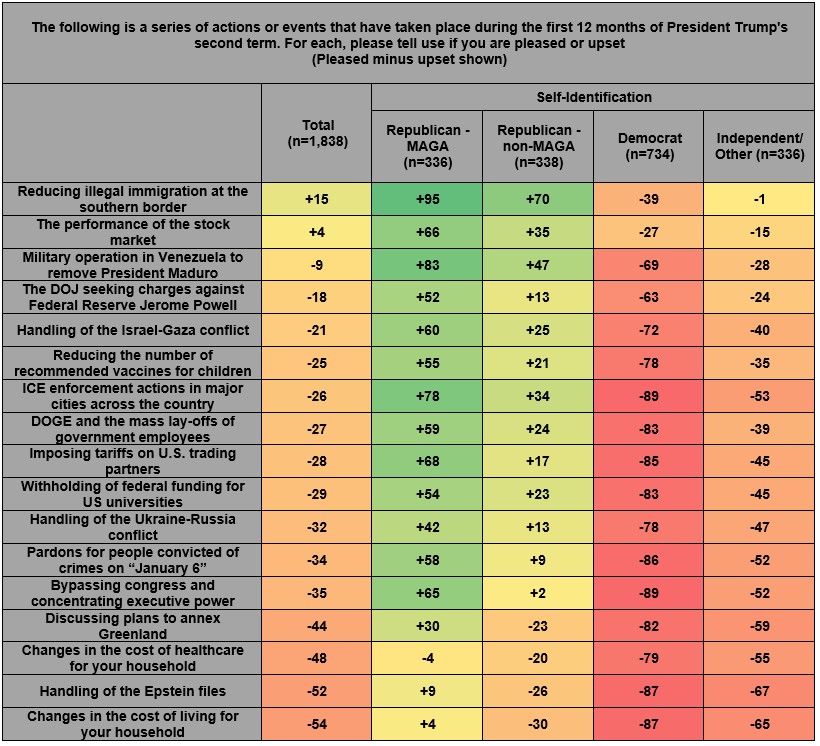 Current priorities for the country
Democrats and Republicans, both MAGA and non-MAGA, can find agreement that the cost of living is a top issue facing the country right now. Health care access also ranks highly as a concern across the political aisle.
There is less agreement on other matters. MAGA Republicans rank border security at the same level as inflation, with health care access, political corruption and national security rounding out their top five concerns.
Immigration falls behind the cost of living for non-MAGA Republicans, although it is still their second-most chosen issue. Health care access and political corruption also rank in non-MAGA Republicans’ top five.
Democrats are much more concerned with the ICE campaign in major cities across the country than other partisans: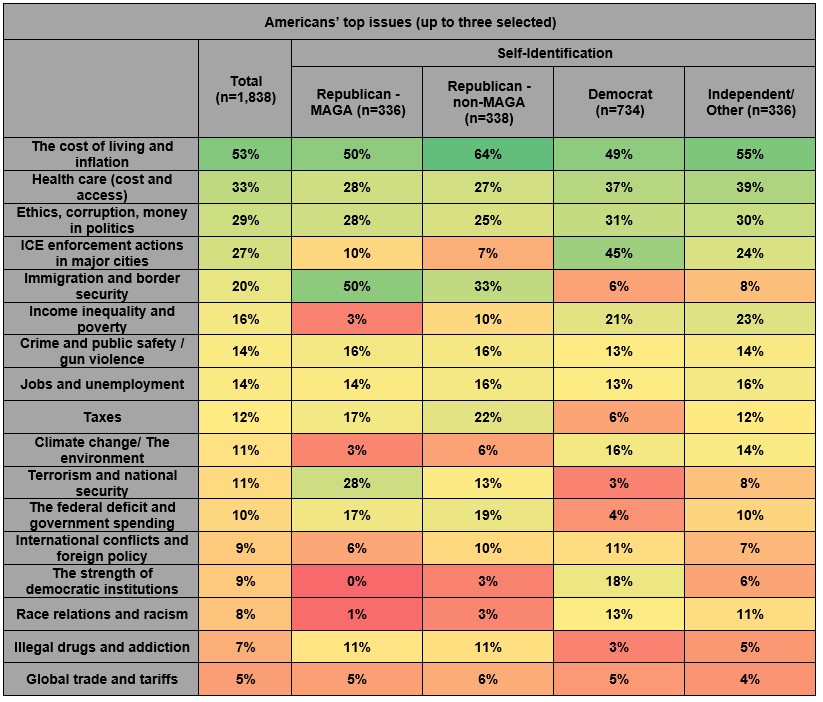 Appraising Trump administration figures
Trump is the global focal point of the last year of U.S. actions but also has a team of appointments and hires who have played a role in the actions and events of the U.S. administration. More Americans disapprove than approve of the performance of Vice President JD Vance, Health Secretary Robert F. Kennedy Jr., Secretary of Homeland Security Kristi Noem, Secretary of State Marco Rubio, Secretary of Defense Pete Hegseth, Attorney General Pam Bondi, Secretary of the Treasury Scott Bessent and Deputy Chief of Staff Stephen Miller, described as Trump’s “ideologue-in-chief”.
Notably, Bessent and Miller are more relatively unknown than other figures in Trump’s administration. Three-in-ten (30%) also offer no assessment of Rubio:
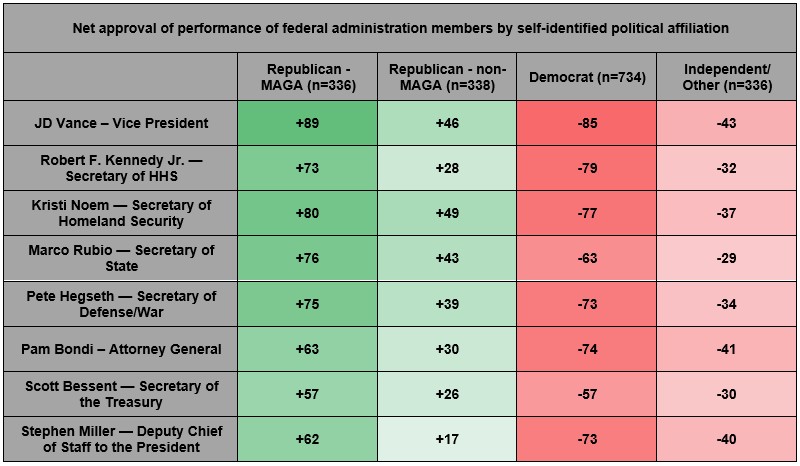
MAGA association is a key delineator in assessments of Trump’s team. Although both MAGA and non-MAGA Republicans alike are more likely to say they approve of the performance of the administration members included in the survey, MAGA Republicans are much more likely to have positive appraisals. Still, disapproval from non-MAGA Republicans of key administration figures peaks at 27 percent for Kennedy; Republicans who don’t identify as MAGA are much more likely to offer no assessment:
Democrats criticized, even by many Democrats
The response of the Democrats in opposition to Trump’s sweeping changes has been criticized. Self-identified Democrats are more likely to disapprove (50%) than approve (41%) of their party’s performance over the past year, which suggests there is more work for the Democratic Party to do to galvanize its voters during this midterm election year:
House and Senate garner poor approval
The threat of a government shutdown still looms, even after the longest one in U.S. history which lasted 43 days over October and November last year. Perhaps that’s why there’s little approval from Americans of the performance of the House of Representatives (24% approve vs. 42% disapprove) and Senate (17% vs. 41%). Americans also have plenty of criticism for the Supreme Court (24% vs. 41%):
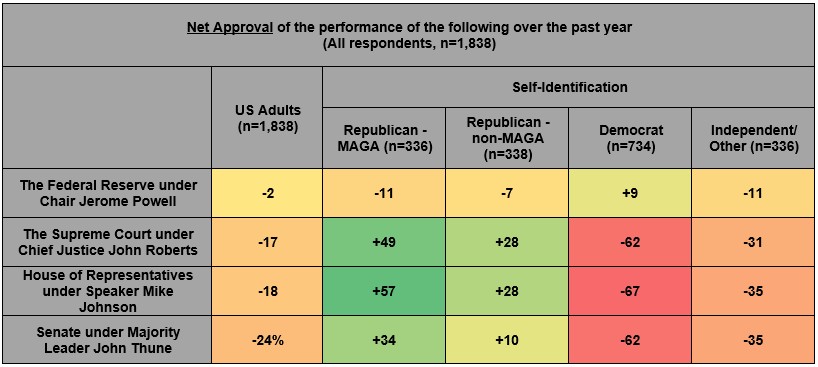
Democrats are driving much of the negativity toward the Supreme Court, the House and the Senate. The Federal Reserve receives more praise than criticism from this group. Non-MAGA Republican are generally approving of those institutions, less so than their MAGA-aligned compatriots. Most offer slight criticism of the Fed.
METHODOLOGY
Angus Reid USA conducted an online survey from January 16 – 20, 2026, among a randomized sample of 1,838 American adults who are members of Angus Reid Forum USA. The sample was weighted to be representative of adults nationwide according to region, gender, age, household income, and education, based on the U.S. census. For comparison purposes only, a probability sample of this size would carry a margin of error of +/- 2 percentage points, 19 times out of 20. Discrepancies in or between totals are due to rounding. The survey was self-commissioned and paid for by ARI. Detailed tables are found at the end of this release.
For detailed results by age, gender, region, education, and other demographics, click here.
For PDF of full release, click here.
For full questionnaire, click here.
MEDIA CONTACTS
Shachi Kurl, President: 1.604.908.1693 shachi.kurl@angusreid.org @shachikurl
Matt Kleinschmit, Managing Director: matt.kleinschmit@reach3insights.com