New data from Angus Reid USA finds the Democratic Party holding an advantage on the question of which party is best to protect democracy in this country, with two-in-five preferring them compared to the Republicans, who are chosen by 27 per cent.
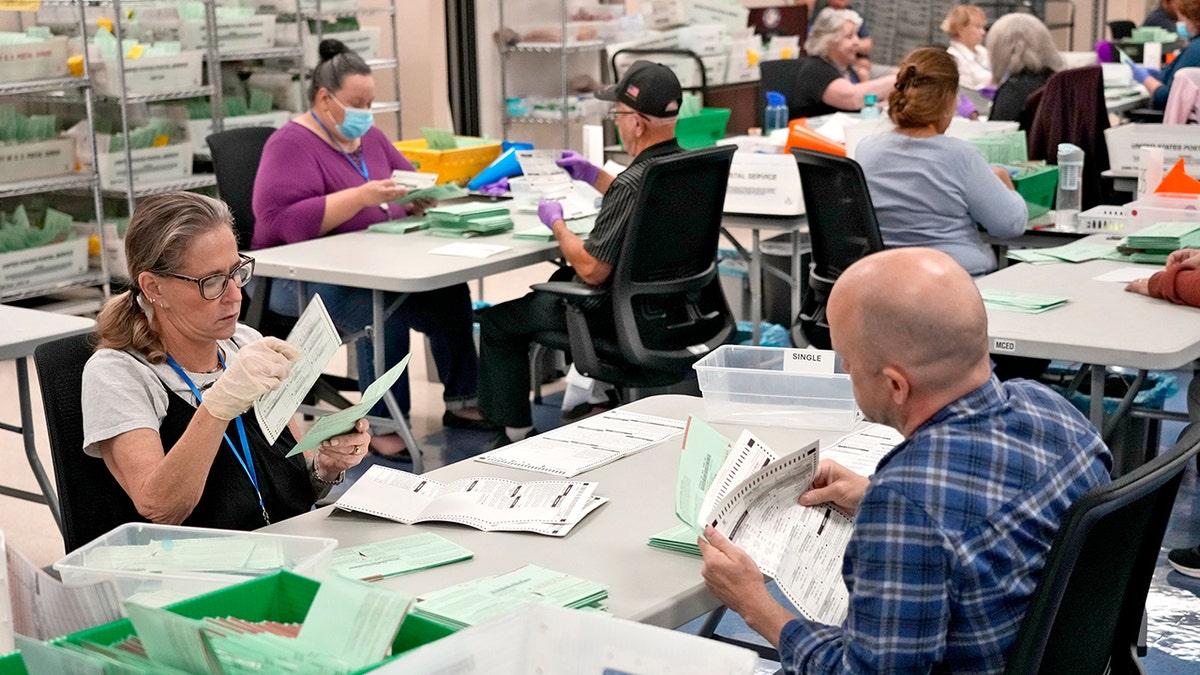
Voters across the country will elect all 435 members of the House of Representatives on November 3, as well as senators in 35 states. Asked if they’re confident that votes will be fairly and accurately counted in their own district, confidence is not widespread. Approximately half (48%) say they’re confident, while 40 per cent are not.
Trust by Party ID
Trust by State
Confidence by Party ID
Confidence by State
Methodology
›
Trust to protect democracy
MAGA Republicans trust the GOP at a far higher rate than Non-MAGA Republicans
Americans overall favor the Democratic Party (39%) over the Republican Party (27%) as the party they trust more to protect democracy and the rule of law. That overall figure masks a divide within the Republican coalition itself: MAGA-identified Republicans trust the Republican Party on this measure at a markedly higher rate (77%) than Non-MAGA Republicans (61%) — a 16-point gap. Democrats are the most internally unified group in the survey, with 81 per cent trusting the Democratic Party most, compared to just 2 per cent who trust the Republican Party. Non-MAGA Republicans are also more than four times as likely as MAGA Republicans to say they trust neither party (17% vs. 3%), suggesting a meaningful pocket of disaffection with both parties among Republicans who do not identify with the MAGA movement.
Angus Reid USA, online survey, Aug. 23–26, 2026, n=1,525 American adults.
Trust to protect democracy
Distrust of both parties climbs as state partisanship intensifies on the Republican side
The state-level pattern moves in the expected direction but with some asymmetry at the extremes. Trust in the Democratic Party runs highest in Deep Blue states (45%) and lowest in Deep Red states (27%), while trust in the Republican Party runs from 19 per cent in Deep Blue states up to 33 per cent in Deep Red states. Notably, Purple states register the highest share trusting the Republican Party of any state category (32%) alongside a still-substantial 41 per cent trusting the Democratic Party — suggesting competitive states aren't simply a midpoint between the two poles. Distrust in both major parties ("neither party") climbs steadily on the Republican side, from 15 per cent in Deep Blue states to 23 per cent in Deep Red states — the highest share recorded across any subgroup in this question.
Angus Reid USA, online survey, Aug. 23–26, 2026, n=1,525 American adults.
Confidence in the vote count
Democrats report the highest confidence the midterm vote count will be accurate
Americans are closely split on whether the results of the 2026 midterm elections will be counted accurately and reflect the votes cast in their district: 48 per cent say they are confident (very confident 21%, confident 27%), while 40 per cent say they are not (not that confident 25%, not at all confident 15%), and 12 per cent are unsure. Democrats report the highest confidence of the three groups (62% net confident), while MAGA and Non-MAGA Republicans report nearly identical, lower levels of confidence (47% net confident for both) — one of the few measures in this survey where the two Republican subgroups align closely with each other rather than splitting apart. MAGA Republicans are nonetheless the group most likely to say they are "not at all confident" in the count (18%), roughly double the rate recorded among Democrats (9%).
Angus Reid USA, online survey, Aug. 23–26, 2026, n=1,525 American adults.
Confidence in the vote count
Confidence in the count follows a U-shaped pattern by state partisanship, bottoming out in Deep Red states
Confidence in the vote count follows a U-shaped pattern by state partisanship rather than a straight line: net confidence is highest in Deep Blue states (51%) and Blue states (51%), dips through Purple (47%) and Red (49%) states, and falls furthest in Deep Red states (37%) — the lowest net confidence recorded for any subgroup in the survey, driven by both elevated "not that confident" (30%) and "not at all confident" (18%) shares. Residents of Deep Red states are also the most likely of any state category to say they are unsure (15%), suggesting confidence in the count is not simply low in these areas but less settled overall.
Angus Reid USA, online survey, Aug. 23–26, 2026, n=1,525 American adults.
About this survey
Methodology and downloads
Angus Reid USA conducted an online survey from Aug. 23–26, 2026, among a representative randomized sample of 1,525 American adults who are members of Angus Reid Forum USA. For comparison purposes only, a probability sample of this size would carry a margin of error of +/- 2.5 percentage points, 19 times out of 20. Discrepancies in or between totals are due to rounding. The survey was self-commissioned and paid for by Angus Reid USA.