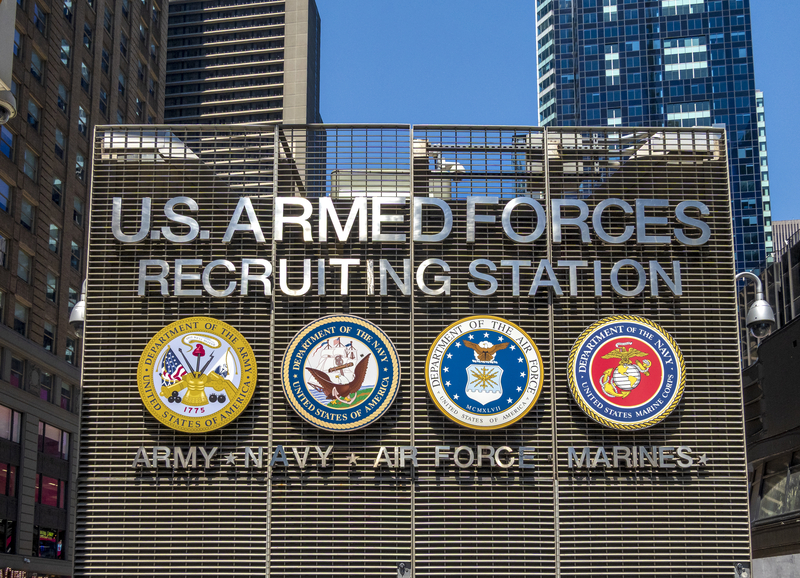
Americans proud of their Armed Forces, but just one-in-three say they would ever volunteer for combat
American pride in the nation's Armed Forces runs wide and deep but pride does not translate into personal willingness to serve. Just one-in-three Americans say they could envision volunteering for a combat role, and the reluctance is sharpest among Democrats and those who hold no strong partisan identity. Among MAGA Republicans, however, the picture looks very different: nearly two-in-three say they would be willing to volunteer.
New data from Angus Reid USA finds 70 per cent of Americans saying they feel proud of the U.S. Armed Forces, while only 32 per cent say they could ever see themselves volunteering for a combat role. The partisan gap is stark: 61 per cent of MAGA Republicans say they would volunteer, compared with just 22 per cent of Democrats. And even as pride in the military remains broadly shared, most Americans — including a majority of MAGA Republicans — say they would not be excited to see their son or daughter enlist.
Key findings
70%
feel proud of the U.S. Armed Forces
32%
would ever volunteer for a combat role
61%
of MAGA Republicans would volunteer — vs. 22% of Democrats
Seven-in-ten proud of Armed Forces, lower levels among Democrats and Independents
Pride in the U.S. Armed Forces is broadly shared but far from uniform. Nationally, 70 per cent of Americans say they feel proud when they think about the military, including 41 per cent who strongly agree. Among MAGA Republicans, near-universal agreement (97%) is driven overwhelmingly by strong sentiment: 82 per cent strongly agree. Non-MAGA Republicans also register high pride at 90 per cent.
Democrats present a starkly different picture. Just 60 per cent express pride in the Armed Forces, and 30 per cent actively disagree — including 16 per cent who strongly disagree. Independents and others fall in between at 61 per cent proud, with 25 per cent disagreeing. Notably, pride is strongly correlated with age nationally: 86 per cent of those 55 and older feel proud, compared to just 57 per cent of 18–34 year-olds.
I feel proud when I think about United States' Armed Forces
One-third would volunteer for combat role, assuming full health and ability
When asked to imagine volunteering for military service in a combat role, just 32 per cent of Americans say they could see themselves doing so — 19 per cent if their country called on them, 13 per cent only if they agreed with the reasons for fighting. A clear majority (57%) say they would not be willing to volunteer.
The partisan divide is profound. Among MAGA Republicans, 61 per cent express willingness to volunteer, including 47 per cent who would respond to their country's call unconditionally. Among non-MAGA Republicans, 51 per cent would volunteer. By contrast, just 22 per cent of Democrats say they would volunteer in any scenario, with 70 per cent saying they would not. Independents sit at the same low level (22%). Men are also notably more likely to say they'd volunteer (45%) than women (21%).
Thinking hypothetically, could you ever see yourself volunteering for military service in a combat role?
W17 · n=1,490
Yes – if my country called on meYes – only if I agreed with the reasonsNo, would not volunteerNot sure / Can't say
Fewer than half would be supportive of their son or daughter joining up
Even among Americans who feel proud of the Armed Forces, translating that pride into personal support for a family member enlisting is a different proposition. Nationally, 45 per cent say they would be supportive of a son joining up, while fewer — 27 per cent — would be excited. For a daughter, the figures are similar: 43 per cent supportive, 33 per cent excited.
The gap between MAGA Republicans and Democrats is especially pronounced. MAGA Republicans are supportive of a son joining at 78 per cent and a daughter at 66 per cent — figures roughly double those of non-MAGA Republicans (67% and 59%). Among Democrats, fewer than one-in-three would be supportive of either a son (30%) or daughter (34%) serving. For excitement, the contrasts are even starker: 52 per cent of MAGA Republicans would be excited to see a son join, compared to just 16 per cent of Democrats.
If I had a young son/daughter, I would be excited/supportive to see them join the United States' Armed Forces
Those most willing to fight are those least likely to be called
The gender gap in combat willingness is wide and consistent: 45 per cent of men say they could see themselves volunteering for a combat role, more than double the 21 per cent of women who say the same. But within that picture lies a striking pattern: among men, willingness to volunteer rises with age. Men 55 and older — past the age of military eligibility in most circumstances — are the most willing of all, at 52 per cent. Men 35–54 match the overall male average at 45 per cent, while men 18–34, those actually of prime fighting age, are the least willing among men at 37 per cent.
Women show no meaningful age gradient — willingness is flat at 19–23 per cent across all age groups, and consistently far below their male counterparts at every stage of life. The result is a population where enthusiasm for combat service is inversely correlated with the practical ability to serve.
Thinking hypothetically, could you ever see yourself volunteering for military service in a combat role?
W17 · % net yes · n=1,490 · Angus Reid USA, April 16–20, 2026
All AmericansMenWomen
Methodology
Angus Reid USA conducted an online survey from April 16 – 20, 2026 among a representative randomized sample of 1,490 American adults who are members of Angus Reid Forum USA. For comparison purposes only, a probability sample of this size would carry a margin of error of +/- 2.5 percentage points, 19 times out of 20. Discrepancies in or between totals are due to rounding. The survey was self-commissioned and paid for by Angus Reid USA. Detailed tables are found at the end of this release.
For detailed results by age, gender, region, education, and other demographics, click here.