
35 per cent approve of Trump’s performance, while 32 per cent support air strikes
March 5, 2026 – It has been less than one week since US and Israeli air strikes on Iran plunged the Middle East, and indeed, the rest of the world, into a tense, twisting and evolving conflict involving countries near and far from the Persian Gulf.
In six short days, Iran’s supreme leader has been killed, proxy wars have begun, millions of expatriates are desperately trying to flee the region, and America’s traditional allies have been choosing between commendation, condemnation, and military co-operation.
But what does America think?
New polling from Angus Reid USA finds nearly half of Americans (47%) oppose the air strikes on Iran, with one-in-three in support and, notably, one-in-five unsure (21%). Those who identify as a part of the MAGA base are near unanimous in their support (85%) while non-MAGA Republicans are more hesitant but still supportive at a slight majority level (56%). Support among Democrats (11%) and Independents (11%) is meagre.
A portion of the MAGA base draws the line at the inclusion of ground troops in this conflict. Opposition rises from two per cent for air strikes to 17 per cent when considering American soldiers with their boots down in Iran. Among non-MAGA Republicans, this idea creates significant division, with two-in-five showing support and the same number opposition (38%). Among democrats and independents, opinion tilts fully the other way, with massive majorities opposed.
As to whether this war will improve the security situation for either Iran or the United States, there is no consensus.
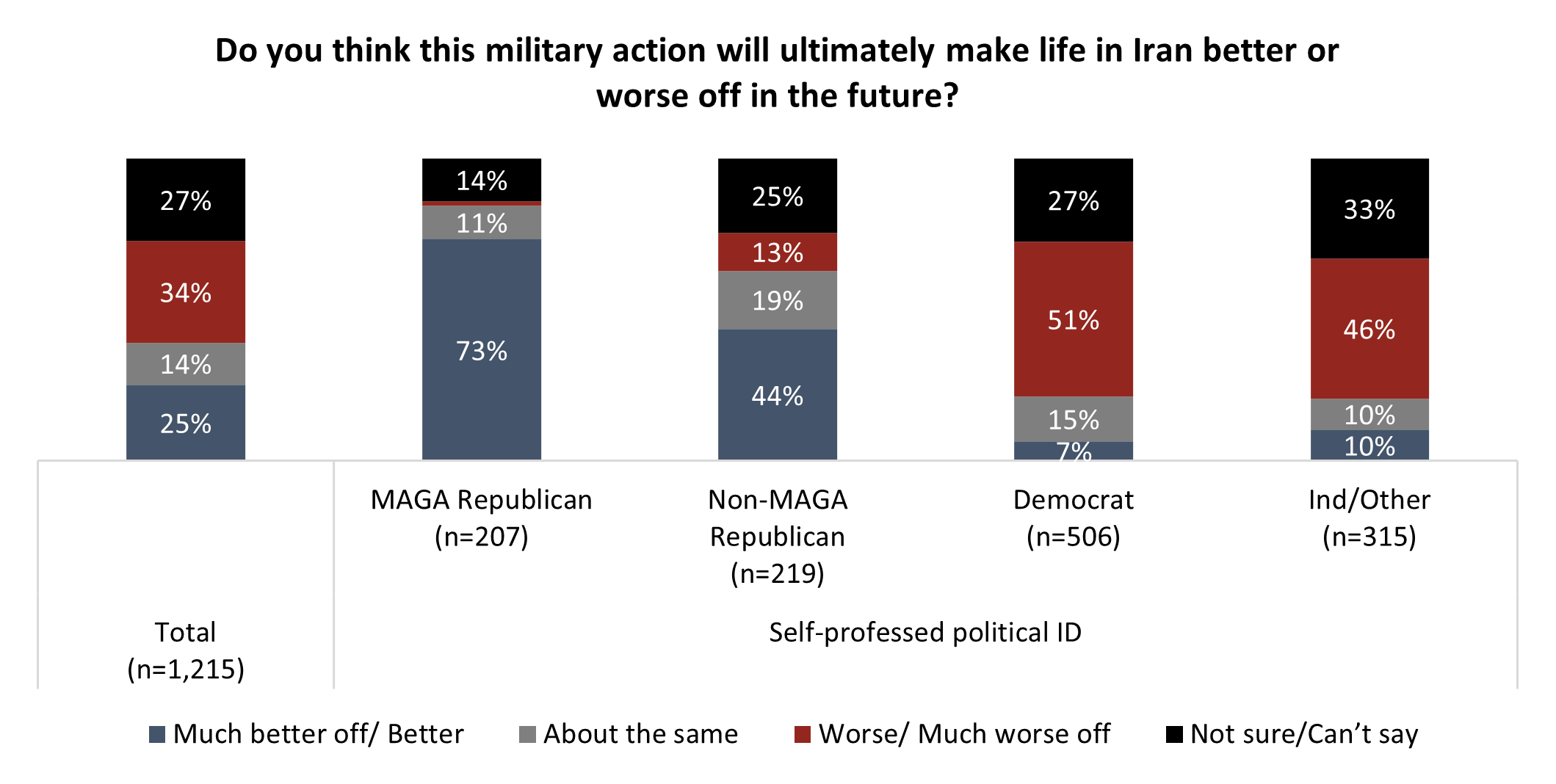
One-quarter (26%) say they believe the U.S. will be safer after what is being called Operation Epic Fury. A larger group say this will lead to less safety for the country (39%). A similar split is found when asking Americans if they think Iran will be better (25%) or worse off (34%). In this case, many aren’t sure (27%).
As the war approaches the one-week mark, many are speculating as to just how long it will last. Communication from the White House has been inconsistent about the timeline, but the idea floated by President Donald Trump that it could last four to five weeks appears unlikely to most. Just one-in-ten Americans say they expect that one month will be enough time to conclude operations. Larger groups say they expect it to take between one month and a year (34%) or longer than a year (31%). One-quarter say they simply don’t know.
INDEX
- Political division on support for strikes
- Majority oppose ground troops in Iran
- Most expect war to last for more than a month
- Trump’s approval rating
- Impacts of the war
Political division on support for strikes
After securing a second term in office in November 2024, President Donald Trump told supporters during his victory speech that he wasn’t going to start wars, “I’m going to stop wars”. He doubled down in his inaugural address several months later: “We will measure our success not only by the battles we win but also by the wars that we end – and perhaps most importantly, the wars we never get into.” As of February 28, the United States has entered into war with Iran, leading many to wonder how his base would respond.
Overall, Americans oppose (47%) more than support (32%) the air strikes, but these opinions are sharply defined by politics. Republicans who identify with the MAGA movement are overwhelmingly supportive (85%) of the attacks on Iran. A majority of non-MAGA identifying Republicans agree (56%), but by a far lower margin. On the other side, most Democrats (74%) and Independents (62%) oppose the military action:

Majority oppose ground troops in Iran
Analysts say it would be difficult, if not impossible, to bring down the Iranian system with US-Israeli air power alone. Trump has said he would deploy ground troops in Iran “if necessary”, but so far the United States has not taken that step.
The escalation of sending American servicemen and women into Iran would be poorly received by a majority of Americans (58%) but more welcomed by Trump’s MAGA base (66%). Non-MAGA Republicans are split between supporting the deployment of troops to Iran (40%) and opposing it (38%):

Most expect war to last for more than a month
Trump’s initial projection is that the war in Iran will last four to five weeks, but also cautioned the U.S. military is able to “go far longer than that”. Few believe the war will last as little as four weeks (10%), while more believe it will last months (34%) or even years (31%). MAGA Republicans are the most likely to believe the war will end within a year (72%) and a majority (59%) of non-MAGA Republicans agree. Those who identify as Democrats or Independent are more likely to believe the war will last months or years:

Trump’s approval rating
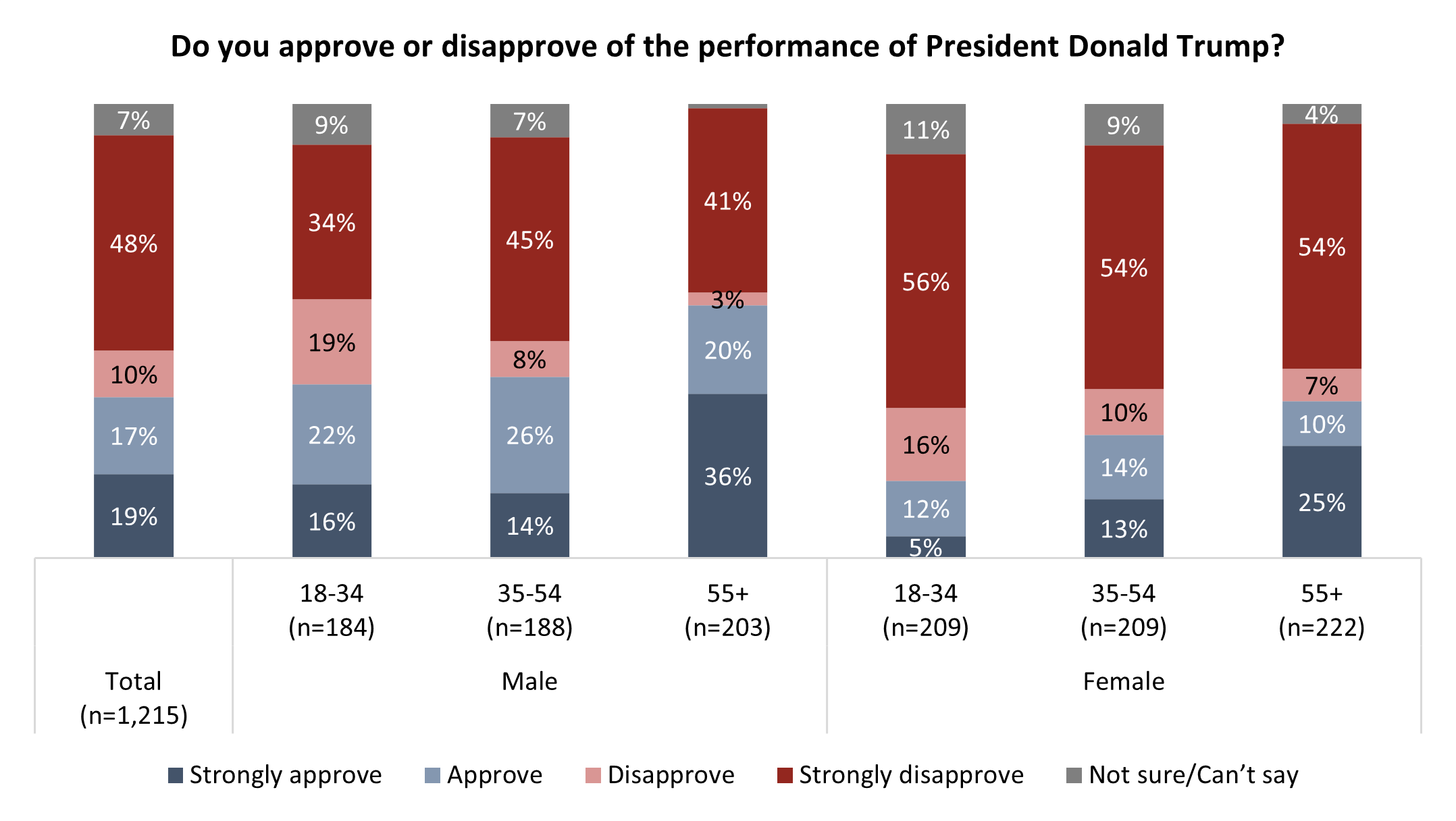
The President’s overall approval rating continues to hover in the mid 30’s, down two points from the last wave of Angus Reid Usa polling. Three-in-five (58%) disapprove while 35 per cent approve.
Men older than 54 are the most positive about Trump’s performance as president, while most women strongly disapprove:
The recent conflict has appeared to have little effect on Trump’s approval rating among his MAGA base, 93 per cent of whom approve of his performance. Non-MAGA Republicans are less effusive in their praise, but still 72 per cent approve of Trump’s performance. Nearly all Democrats (92%) and most Independents (69%) offer negative reviews:

Impacts of the war
Although changing the regime of Iran was a primary target during this war, Trump has also stated that the goal of the recent air assault on Iran is to prevent it from developing a nuclear weapon and remove the threat of Iranian missiles which he claims “could soon reach American homeland”. Iranian state media has claimed their country is developing a missile capable of hitting the U.S., according to Reuters.
Americans overall are more likely to believe the war in Iran will have no effect on the safety of the U.S. (23%) or make it less safe (39%) than they are to believe it will protect the U.S. (26%).
Self-identified MAGA Republicans are most convinced (76%) military action in Iran will make the U.S. safer, while non-MAGA Republicans are divided between believing it will improve the safety of the U.S. (41%) and not. Majorities of Democrats (58%) and Independents (53%) believe the bombing campaign will make the world more dangerous for the U.S.:

MAGA Republicans, too, are most convinced (73%) life in Iran will improve after this war is over. A plurality of non-MAGA Republicans agree (44%), but significant minorities in that group believe life will be the same (19%) or worse (13%) for Iranians once the military action is over.
Democrats (51%) and Independents (46%) are the most likely to believe this war will only worsen the day-to-day lives of the Iranian people:
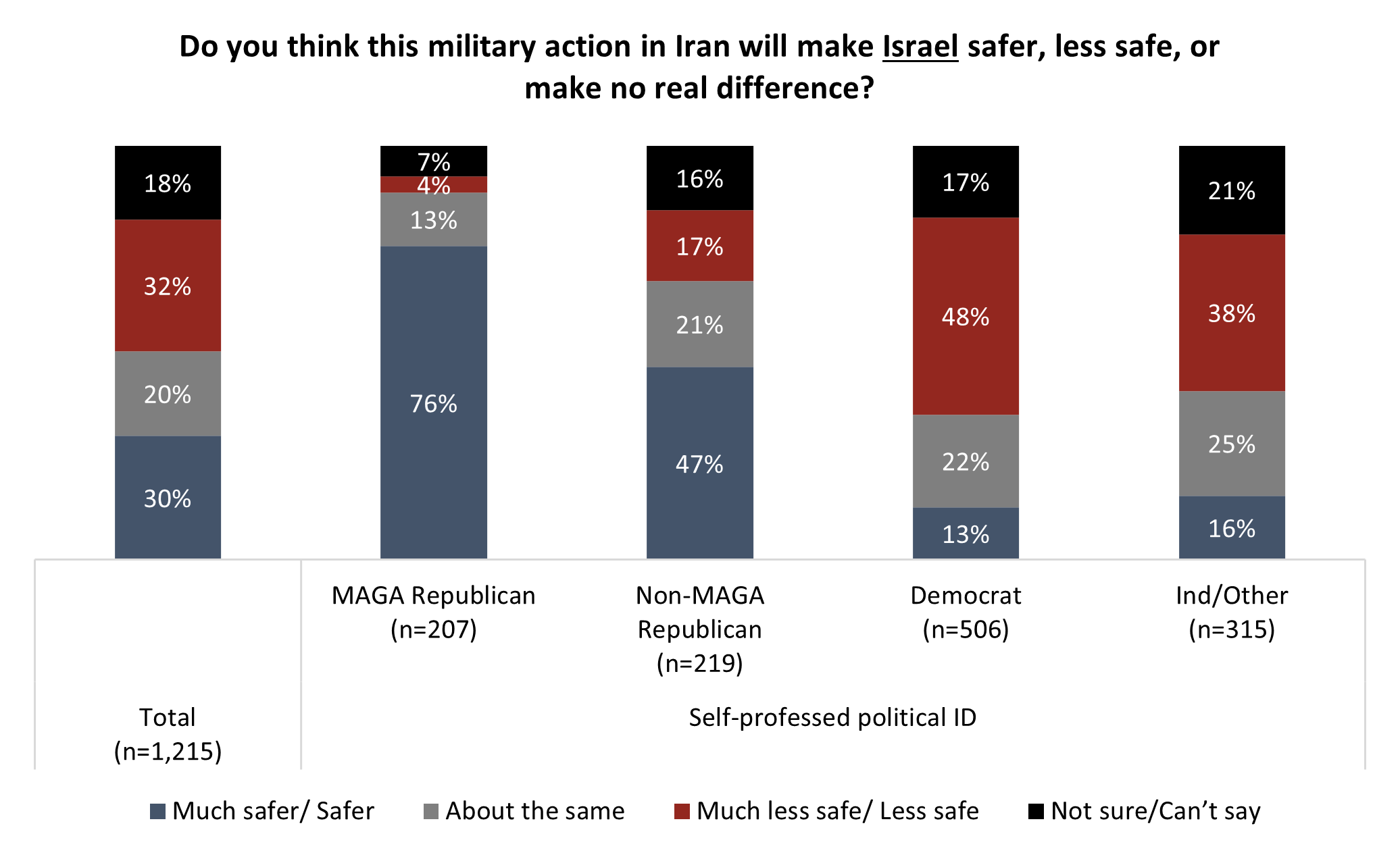
By a slim margin, Americans are more likely to believe this military campaign in Iran will make Israel safer (30%) than their own country (26%, see above).
Politics appears to play a big role in this question as well. Three-quarters (76%) of MAGA Republicans believe Israel will be safer after these airstrikes; approaching half (47%) of non-MAGA Republicans agree. Pluralities of Democrats (48%) and Independents (38%) believe instead that Israel will be in a more dangerous position post-war than it was before:
METHODOLOGY
| Angus Reid USA conducted an online survey from March 2 – 4 2026 among a representative randomized sample of 1,215 American adults who are members of Angus Reid Forum USA. For comparison purposes only, a probability sample of this size would carry a margin of error of +/- 3 percentage points, 19 times out of 20. Discrepancies in or between totals are due to rounding. The survey was self-commissioned and paid for by Angus Reid USA. Detailed tables are found at the end of this release. |
For detailed results by age, gender, region, education, and other demographics, click here.
For PDF of full release, click here.
For questionnaire, click here.
MEDIA CONTACTS:
Angus Reid, Chairman: angus@angus.org @AngusReid
Shachi Kurl, President: 1.604.908.1693 shachi.kurl@angusreid.org @shachikurl