
Americans agree Russia started the war and Russia is prolonging it
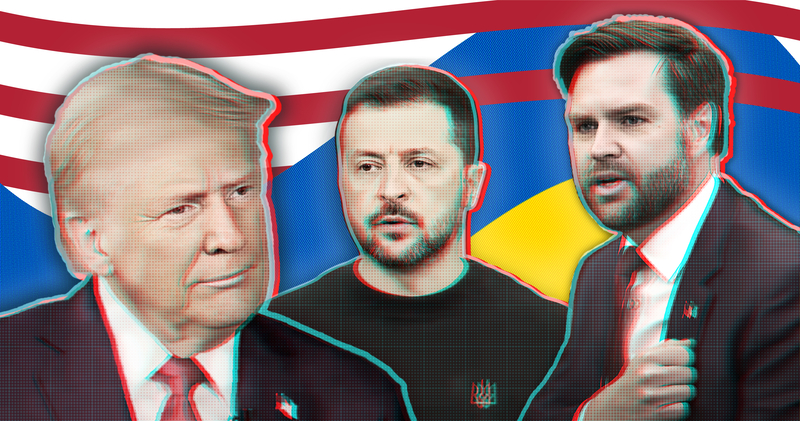
March 11, 2025 – After a seemingly calm conversation in the oval office exploded between American President Donald Trump, Vice President J.D. Vance, and Ukrainian President Volodymyr Zelenskyy, many Americans have taken a renewed interest in the conflict underlying it. And while U.S. officials are hopeful of “significant progress” during peace talks this week in Saudi Arabia, few have faith in Trump’s boast that he would bring the war to an end within his first 100 days in office.
New data from the Angus Reid finds residents dubious that the war will be brought to an end by April 29, Trump’s 100th day of his second term. More than half of Americans (54%) view this prospect as unlikely, even as the parties meet in Saudi Arabia this week.
Trump’s position on Russia has been criticized in recent weeks, after he appeared to blame Ukraine for starting the war. On this he is out of step with his own country, his own supporters, and Canadians. Seven-in-10 Americans say Russia began this conflict, while 82 per cent of Canadians agree. Just 16 per cent of Trump voters agree with him that Ukraine is to blame, while 63 per cent blame Russia.
With negotiations ongoing, but the productivity coming out of them uncertain, there is a sense among Americans that Ukraine stands to lose if Trump is the one making a deal. Most say Russia (54%) will benefit, while fewer than half say the U.S. (42%) or Ukraine (30%) will see value.
More Key Findings:
- Half of Americans say they are following the conflict closely (52%).
- A majority say it “feels like we are on the path to World War Three” (56%)
Russia seen as clear instigator
Asked who is most responsible for starting the war, nearly three-quarters of Americans (72%) say Russia bears primary responsibility. Just eight per cent place blame on Ukraine, while one-in-five (20%) say they are unsure or cannot say.
This view is consistent across regions, age groups, income levels, and education. Majorities in every region — including the South (76%) and Midwest (76%) — assign responsibility to Russia, as do both men (75%) and women (69%). Older Americans are especially likely to blame Russia, with 79 per cent of those aged 55 and older holding this view, compared to 65 per cent of those aged 18–34.
Political divisions are evident but do not erase the overall consensus. Nearly nine-in-ten Americans who voted for Kamala Harris in 2024 (88%) say Russia is responsible for starting the war, compared to 63 per cent of Trump voters. Among those who did not vote, fewer than six-in-ten (59%) assign blame to Russia, with a much larger share saying they are unsure.
Responsibility for war’s duration less clear-cut
When asked a related but distinct question — who is most responsible for the war lasting as long as it has — agreement weakens. A majority (58%) still point to Russia, but this represents a notable drop from views on who started the conflict. Meanwhile, the share blaming Ukraine doubles to 16 per cent, and more than one-quarter (26%) say they are unsure.
Younger Americans are significantly more uncertain on this question. Among those aged 18–34, nearly three-in-ten (28%) say they cannot say who is responsible for the war’s duration, compared to just 21 per cent among those aged 55 and older. Women are also more likely than men to express uncertainty.
Partisan gaps widen considerably. While more than eight-in-ten Harris voters (82%) continue to blame Russia for the prolonged conflict, fewer than half of Trump voters (41%) agree. One-third of Trump voters (32%) say Ukraine is responsible, and more than one-quarter (27%) say they are unsure. Among Americans who did not vote in 2024, uncertainty dominates: nearly half (46%) say they cannot say who is responsible for the war continuing.
METHODOLOGY
Angus Reid conducted an online survey from Feb. 27 to March 3, 2025 among a representative randomized sample of 2,005 American adults who are members of Angus Reid Forum USA. For comparison purposes only, a probability sample of this size would carry a margin of error of +/- 2 percentage points, 19 times out of 20.
Discrepancies in or between totals are due to rounding. The survey was self-commissioned and paid for by ARI. Detailed tables are found at the end of this release.
MEDIA CONTACTS:
Shachi Kurl, President: 604.908.1693 shachi.kurl@angusreid.us @shachikurl
Dave Korzinski, Research Director: 250.899.0821 dave.korzinski@angusreid.us
For detailed results by age, gender, region, education, and other demographics, click here.