

Civic engagement heavily correlates with increased trust in institutions, from police, to schools, to courts
February 20, 2026 – New data from Angus Reid USA find that faith and community engagement are closely intertwined in American life – and that both are linked to higher levels of institutional trust – a rare phenomenon these days.
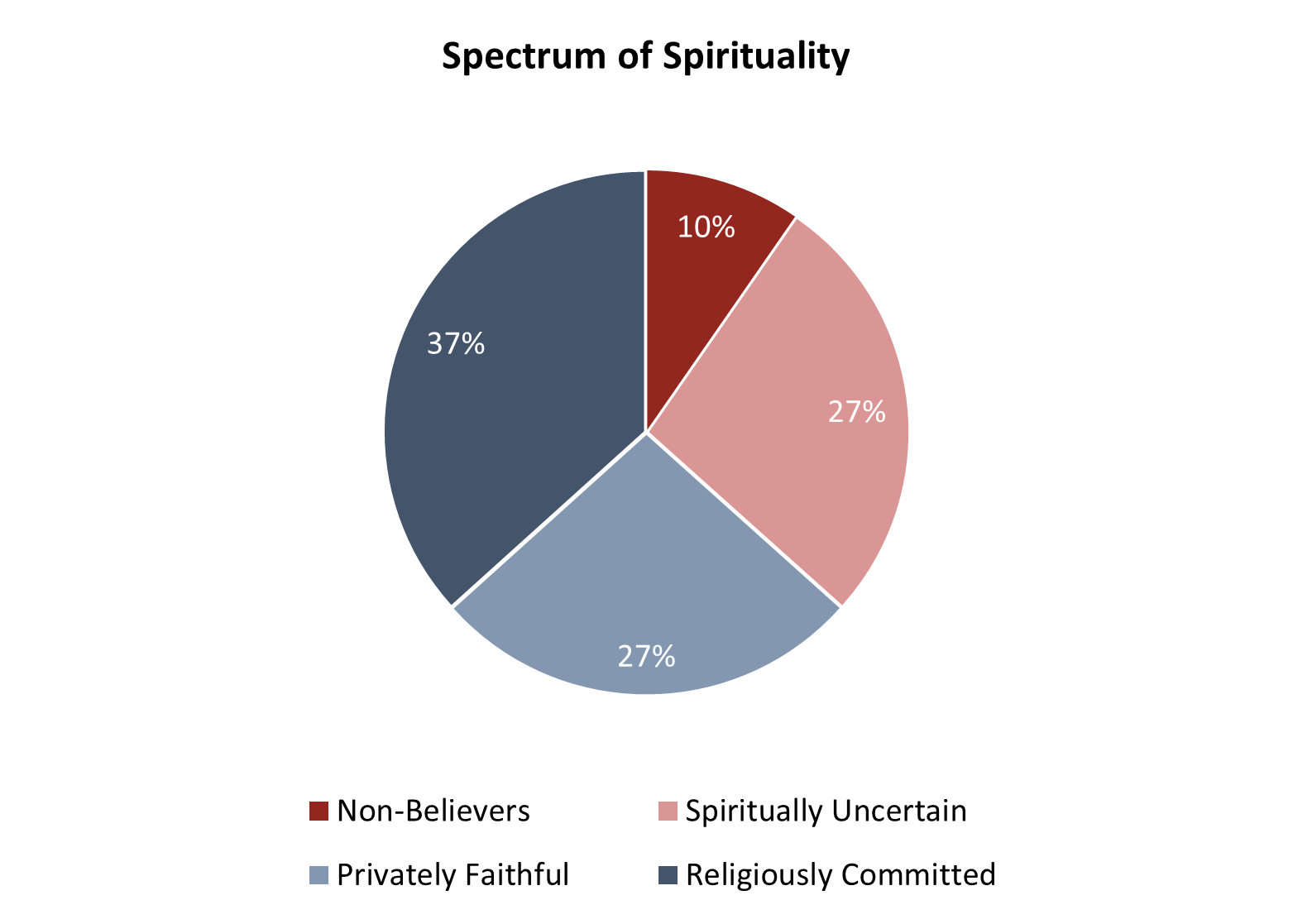
Americans who are more Religiously Committed on Angus Reid’s Spectrum of Spirituality are significantly more likely to volunteer, donate to causes, take up a hobby, and socialize with neighbours. This group is the largest in the Spectrum, representing 37 per cent of Americans. The Privately Faithful – 27 per cent of the population – engage in many of the same activities but to a slightly lesser extent. The smallest group – non-Believers (10%) – are the least likely of all to engage in any sort of helping community endeavors.
Importantly, faith underscores community involvement, and community involvement appears to underscore significantly increased trust in institutions.
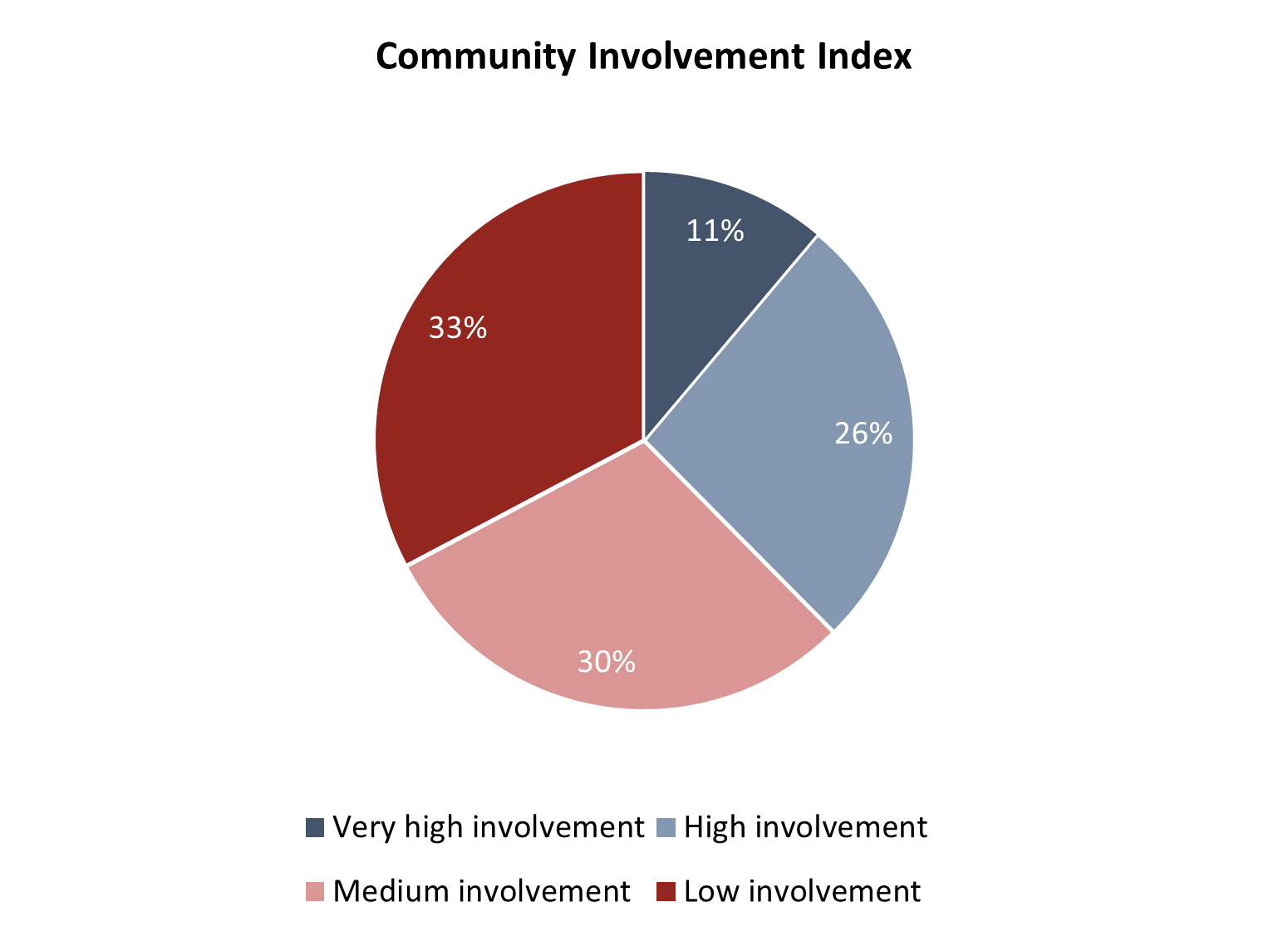
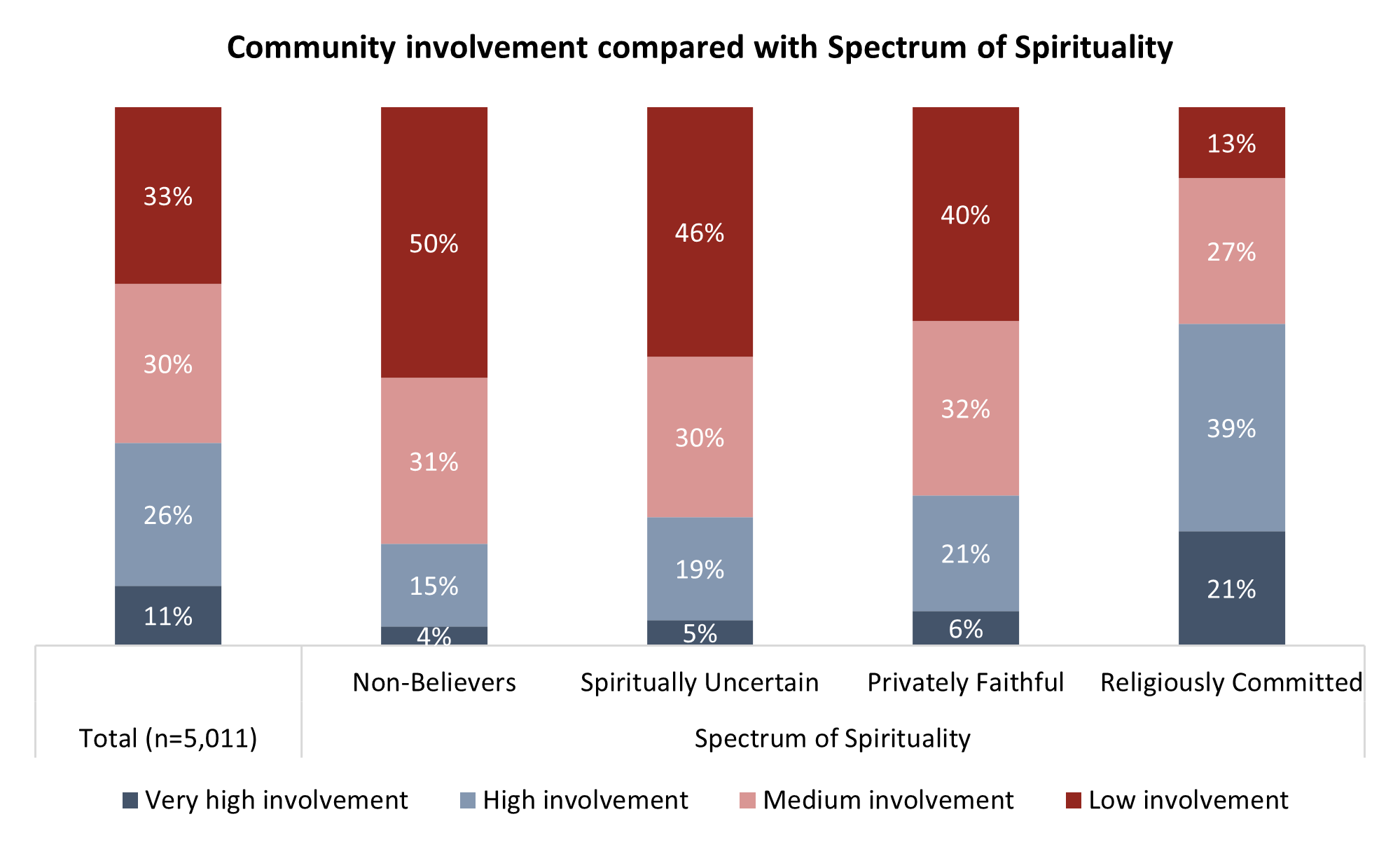
Using participation in activities across numerous categories, Angus Reid identifies 11 per cent of Americans as having a “very high” level of community involvement and 26 per cent as “high”. Larger groups have medium (30%) or low (33%) involvement. Civic involvement has a significant correlation to increasing public trust when it comes to police, government, public education, churches and myriad other common institutions.
INDEX:
Part One: The Spectrum of Spirituality in America
- Faith and confidence in institutions
- Faith and community involvement
Part Two: The Community Involvement Index
- High-community involvement coincides with greater levels of institutional trust
Part One: The Spectrum of Spirituality in America
Angus Reid researchers created this composite index based on the responses to several questions about faith and experience with God or a higher power. The following factors were measured in the data analysis:
- Belief in God or a higher power
- Belief in life after death
- How often, if at all, a person prays to God or a higher power
- How often a person attends religious services
- How often a person reads the Bible or other sacred text
- How often a person feels they experience God’s presence
- How important it is to a person that their child to be educated about faith and involved in a faith-based community
Researchers used respondents’ answers to these questions to create a continuum of faith, with those providing more answers indicating belief near the high end, and those with fewer answers suggesting a degree of personal faith near the low end. This creates four distinct groups: Non-Believers, Spiritually Uncertain, Privately Faithful and Religiously Committed.
Faith and confidence in institutions
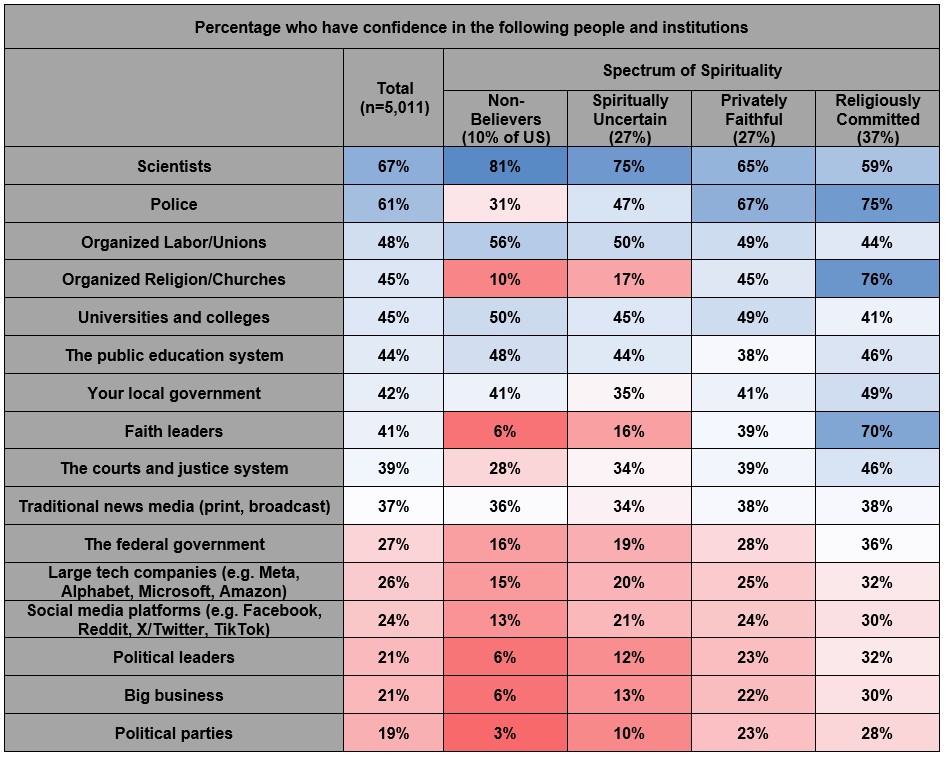
So, what role does faith play in institutional confidence? Perspectives vary sharply across the Spectrum of Spirituality, with some of the widest gaps appearing around religion and authority. Overall, scientists (67%) and police (61%) command the highest levels of trust, but Non-Believers are especially likely to express confidence in scientists (81%) while showing much lower trust in organized religion (10%) and faith leaders (6%). By contrast, the Religiously Committed place overwhelming confidence in organized religion (76%) and faith leaders (70%) and are also more likely than others to trust police (75%) and political institutions. Across all groups, political parties (19%), big business (21%), and political leaders (21%) rank near the bottom, underscoring a broad-based skepticism toward partisan and corporate power regardless of spiritual orientation.
Faith and community involvement
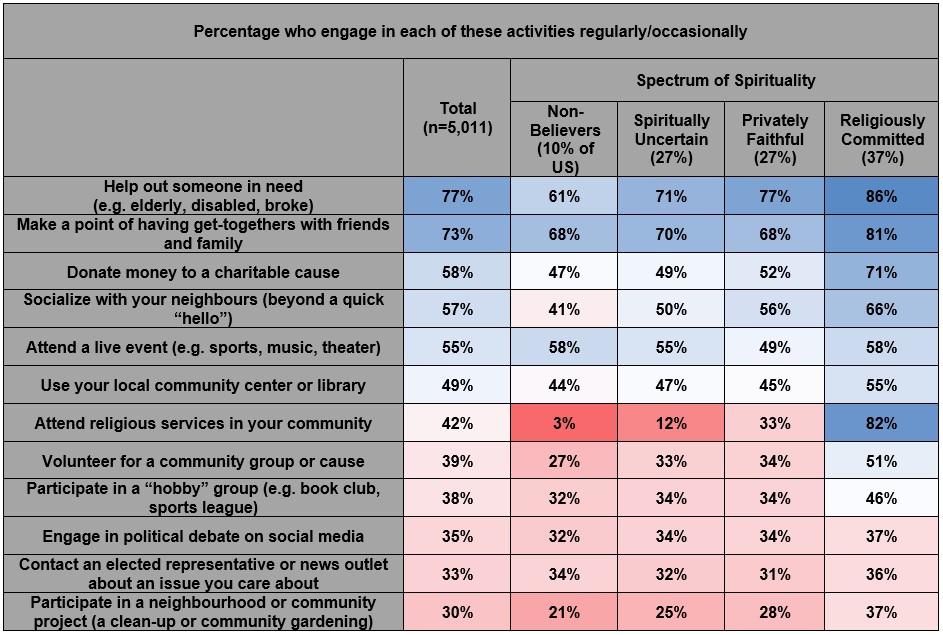
Faith also appears to coincide with stronger social connections and more involvement in one’s community. Fully 86 per cent of the Religiously Committed say they regularly or occasionally help someone in need, compared to 61 per cent of Non-Believers, and four-in-five (81%) make a point of gathering with friends and family, comfortably above other groups. Majorities of the Religiously Committed also donate to charity (71%), socialize with neighbours (66%), and volunteer (51%), outpacing their less religious counterparts. While differences narrow on activities such as attending live events or engaging in online political debate, the overall pattern suggests that faith commitment is associated with deeper and more frequent engagement in both formal and informal community life.
Part Two: The Community Involvement Index
To assess how community involvement is connected to politics, views of institutions, and other matters, ARI and Cardus queried Americans on their activities in the community to gauge civic participation. These data – including how often respondents volunteered or donated money, helped out those in need in other ways, used local community centres or libraries, socialized with neighbours, participated in neighbourhood projects or hobby groups, or attended religious services – were amalgamated to create the Community Involvement Index, which sorts people by how often they spend time in their community. (See the scoring of the index here).
The Community Involvement Index finds about one-in-10 in Canada and the U.S. who have “very high” involvement. That is, they are doing most of the above activities regularly. Those in the “high” involvement group are doing many of those activities, but perhaps less frequently. The “medium” involvement group are doing fewer activities overall, while the “low” involvement group rarely does any activities in their community at all.
Using this measure, one can garner a more comprehensive idea of the correlation between faith and community involvement. Three-in-five (60%) of the Religiously Committed have either a high or very high level of involvement. As someone becomes less faith-based in their worldview, they also appear to recede further from their communities:
High-community involvement coincides with greater levels of institutional trust
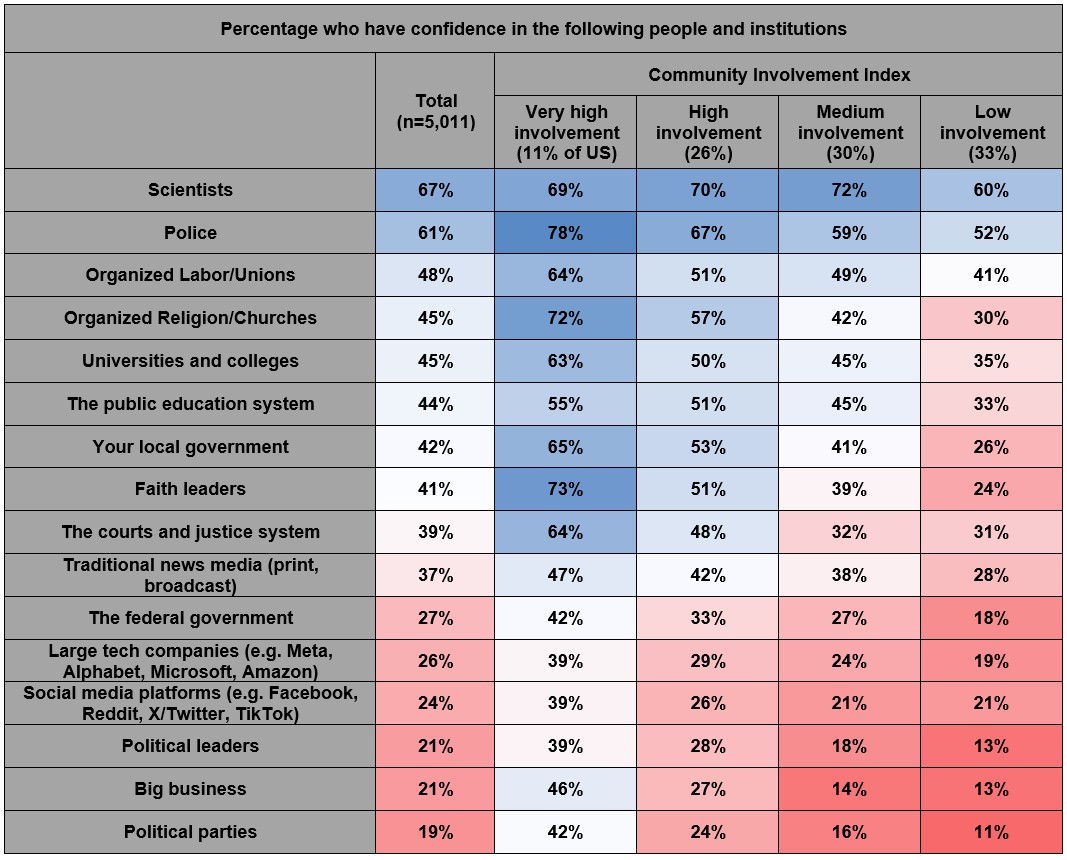
Institutional trust tracks even more closely with community involvement than with faith alone. Across nearly every measure, those with very high involvement in their communities express substantially greater confidence in institutions than those with low involvement. For example, confidence in police rises from 52 per cent among the least involved to 78 per cent among the most involved, while trust in local government more than doubles (26% to 65%). Similar gaps appear for faith leaders (24% vs. 73%), organized religion (30% vs. 72%), and the courts (31% vs. 64%).
Even typically low-trust institutions such as political parties (11% vs. 42%) and political leaders (13% vs. 39%) see markedly higher confidence among the highly engaged. While trust in scientists remains comparatively strong across all groups, the overall pattern is clear: deeper community participation corresponds with broader and more consistent institutional trust, reinforcing the idea that civic engagement and confidence in public life are closely intertwined. The problem for those trying to increase trust is that the “very high involvement” group represents just 11 per cent of the population.
For detailed results by age, gender, region, education, the Spectrum of Spirituality and the Community Involvement Index, click here.
For PDF of full release, click here.
CONTACT:
Angus Reid, Chairman: angus@angus.org @AngusReid
Shachi Kurl, President: 1.604.908.1693 shachi.kurl@angusreid.org @shachikurl