Americans want AI heavily regulated, but most doubt any government can keep up with the technology
As the AI boom accelerates and the physical footprint of the technology spreads into communities across the country, Americans are sending a clear signal to Washington: take a firm hand with the technology itself, while bracing for a fight over where its infrastructure gets built. The public wants regulation, but it does not believe government is equipped to deliver it — and when the conversation turns from AI in the abstract to a data center down the street, support evaporates almost everywhere.
New data from Angus Reid USA finds 58 per cent of Americans saying government must heavily regulate AI and tech companies, even if it slows development, while just 21 per cent would leave it to the companies to self-regulate. At the same time, 59 per cent say no government is truly equipped to regulate AI quickly enough to keep pace with the technology. That skepticism extends to adoption: 69 per cent say government should be cautious about adopting AI given the risk of unintended consequences, rather than rushing to integrate it into public services.
Key findings
58%
want heavy AI regulation, even if it slows development
59%
say no government is equipped to keep pace with AI
Americans want heavy regulation, even if it slows down development
Asked directly which view comes closer to their own, 58 per cent of Americans say government must heavily regulate AI and tech companies, even if doing so slows development. Just 21 per cent say government should leave this to tech companies to self-regulate, while 21 per cent are unsure.
Which of the following comes closer to your own view about artificial intelligence and regulation?
QSR2 · n=2,007
Must heavily regulateLeave it to tech companiesNot sure
The desire for regulation crosses party lines, though not evenly. Democrats are the most likely to want heavy-handed rules (69%), while Republicans are split more narrowly (51% heavy regulation vs. 26% self-regulation). Those registered with neither major party fall in between.
Which of the following comes closer to your own view about artificial intelligence and regulation?
QSR2 · by registered party · n=2,007
Even as the appetite for regulation is broad-based, confidence that any government can actually deliver it is in short supply. 59 per cent of Americans say no government — in the U.S. or anywhere else — is truly equipped to regulate AI quickly enough to keep pace with the technology, while just 23 per cent believe governments are capable of doing so effectively as it develops.
Thinking about governments in the U.S. and around the world, which statement comes closer to your own opinion?
QSR4 · n=2,007
Governments are capableNo government is equipped to keep paceNot sure
That skepticism carries directly into how Americans think government itself should use AI. 69 per cent say government should be cautious about adopting AI given the risk of unintended consequences, compared to just 17 per cent who want government to actively invest in and adopt the technology to streamline public services.
Which comes closer to your own view?
QSR3 · n=2,007
Invest in and adopt AI quicklyBe cautious due to risksNot sure
Job loss anxiety runs deep
Concern about AI's impact on jobs is one of the most consistent findings in this survey, regardless of how the question is framed. Asked how AI will change the American job market over the next decade, 42 per cent of Americans say it will significantly reduce the number of available jobs, while just 6 per cent expect a significant increase. Another 40 per cent foresee a mixed picture, with some jobs lost and others gained.
How do you think AI will change the American job market in the next 10 years or so?
Q12 · n=2,007
Significant reduction in jobsMixed: some losses, some gainsSignificant increase in jobsLittle/no impactNot sure
Worry about AI replacing one's own job specifically is more muted than worry about the labor market broadly: just 26 per cent say they are personally worried about AI replacing their own job, while 66 per cent see it instead as a tool to enhance their work, or are simply not very worried. That gap — between a grim macro outlook and comparative personal confidence — suggests Americans see the threat as real but somewhat abstract, something happening to "the job market" more than to themselves specifically.
Data centers a hard sell, wherever they're proposed
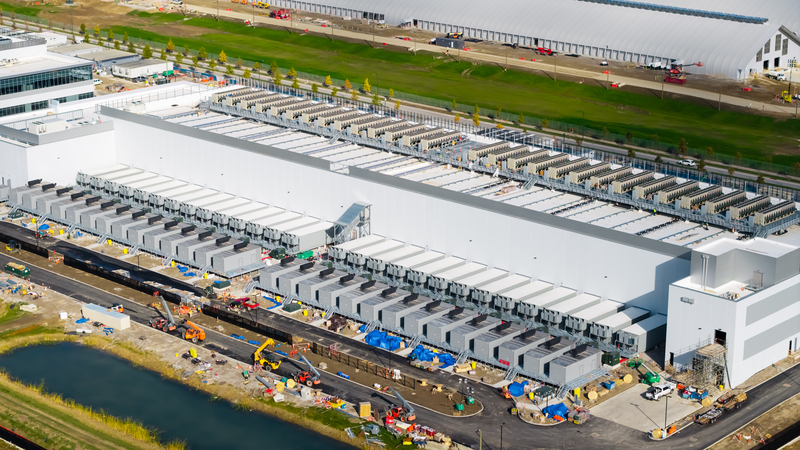
The infrastructure race behind the AI boom has moved from data centers as an abstraction to data centers as a neighborhood issue. The pace of new construction has triggered a wave of organized local resistance: research firm Data Center Watch found that at least 75 data center projects worth more than $130 billion were blocked or delayed in the first quarter of 2026 alone — matching the total for all of 2025 — with active opposition groups spanning 49 states.
Some of the highest-profile fights have played out far from the usual tech hubs. In Box Elder County, Utah, hundreds of residents turned out to oppose a 40,000-acre data center campus, with opponents now pushing for a ballot referendum to overturn the county's approval. In Virginia, long considered ground zero for data center growth, a coalition of environmental and homeowner groups has organized to slow new projects. New York's legislature passed a one-year moratorium on large data center permits, while a similar bill in Maine was vetoed by the governor after passing the statehouse.
Against that backdrop, it's little surprise that data center construction faces a skeptical American public almost everywhere. Asked whether they would support or oppose a large AI data center being built within a few blocks of where they live, two-thirds (67%) of Americans oppose the idea, while just 17 per cent support it and 15 per cent are unsure.
If a large AI data center was proposed within a few blocks of where you live, would you support or oppose it being built there?
QDC1 · n=2,007
Opposition is broadly consistent across demographic lines, though a few patterns stand out. Women oppose data centers near their homes at a higher rate than men (71% vs. 64%). Opposition is also somewhat higher among older Americans (73% among those 55+) than younger adults (65% among those 18–34), though even the youngest age group opposes the idea by nearly three-to-one.
Regionally, opposition is fairly uniform, ranging from 64 per cent in the West — home to a wave of new data center proposals in states like Colorado and Utah — to 70 per cent in the Northeast.
If a large AI data center was proposed within a few blocks of where you live, would you support or oppose it being built there?
QDC1 · by region · n=2,007
Weighing the pros and cons
Pressed on the broader cost-benefit calculation, Americans see some real upside to large AI data centers, but the case grows weaker the closer the impact gets to daily life. The most positive assessment is reserved for America's ability to compete globally in AI and technology, where 36 per cent call data centers a good thing and 26 per cent call them bad — the only dimension tested where the positive view outweighs the negative.
Views are more closely divided on the economic case closer to home: 27 per cent say data centers are good for businesses and the economy versus 39 per cent who say bad, and a similar split holds for tax revenues for local governments (26% good, 34% bad). On job creation specifically, only 21 per cent see a net positive against 46 per cent who see a net negative — a sharp rebuke to one of the industry's central selling points to local communities.
The clearest negatives are environmental and local. 60 per cent say data centers are bad for energy and environmental sustainability. A nearly identical share, 59 per cent, say data centers are bad for neighborhoods and surrounding communities — underscoring the central tension facing both government and industry as they try to sell AI infrastructure as a national priority while reassuring the communities asked to live next to it.
Overall, do you think large AI data centers and computing facilities are a good thing or bad thing for each of the following?
QDC2 · n=2,007
Net good thingNet bad thing
Methodology
Angus Reid USA conducted an online survey from June 12–19, 2026, among a representative randomized sample of 2,007 American adults who are members of Angus Reid Forum USA. For comparison purposes only, a probability sample of this size would carry a margin of error of +/- 2.0 percentage points, 19 times out of 20. Discrepancies in or between totals are due to rounding. The survey was self-commissioned and paid for by Angus Reid USA. Detailed tables are found at the end of this release.
For detailed results by age, gender, region, education, and other demographics, click here.