
Democracy remains the preferred system for most Americans, but a sizeable minority—particularly Trump voters and those who sat out 2020—show openness to authoritarian alternatives
November 7, 2022 –
A new U.S. survey finds that while Americans remain overwhelmingly attached to democratic government, large and politically consequential minorities are open to models that weaken or bypass it. Strongman leadership, technocratic rule by experts, and even military governance all draw meaningful support, especially among those aligned with former president Donald Trump.
The result is not a country abandoning democracy—but one showing growing cracks beneath its surface.
Democracy still dominates — but not universally
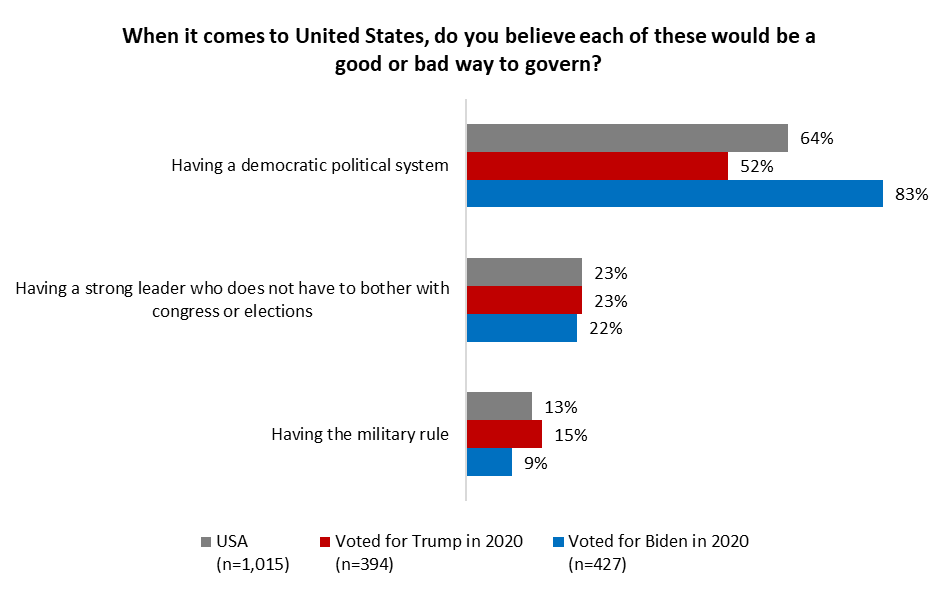
When asked whether having a democratic political system is a good or bad way to govern the United States, nearly two-thirds of Americans (64%) say it is a great or good way. Just 19% describe democracy as a bad or terrible system, while 17% are unsure.
Support is particularly strong among:
-
Joe Biden voters (83%)
-
College-educated Americans (79%)
-
Higher-income households (76%)
-
Younger men (71%)
But among Trump voters, democratic commitment drops sharply: just 52% say democracy is a good way to govern, while nearly one-third (32%) say it is a bad or terrible system. Among those who did not vote in 2020, skepticism is even stronger, with 44% rejecting democracy.
This cleavage is also visible by state type: support for democracy runs at 65% in blue states, but falls to 61% in red states.
Strongman leadership divides America
Despite broad democratic support, Americans are far from united in rejecting authoritarian leadership.
Asked whether “having a strong leader who does not have to bother with Congress or elections” would be a good way to govern, nearly one-quarter (23%) say yes, while 62% say it would be a bad or terrible idea.
But partisan divides are stark:
| Group | Strongman is good | Strongman is bad |
|---|---|---|
| Trump voters | 23% | 64% |
| Biden voters | 22% | 67% |
| Non-voters | 29% | 43% |
| Red states | 22% | 59% |
| Blue states | 22% | 58% |
| Swing states | 26% | 68% |
The strongest resistance comes from older Americans, women, and the college-educated, where roughly three-quarters reject this form of rule.
But among men under 35, support climbs to 27%, suggesting younger males are among the most open to strongman governance.
Military rule is overwhelmingly rejected — except among Trump voters
Americans draw a much harder line when it comes to military rule.
Fully 75% of Americans say having the military run the country would be a bad or terrible idea. Only 13% say it would be a good way to govern.
Yet again, partisan differences stand out:
-
Trump voters: 15% say military rule would be good
-
Biden voters: just 9%
-
Non-voters: 16%
Opposition is strongest among:
-
Women (79%)
-
College graduates (87%)
-
High-income households (82%)
Experts running the country? Americans are split
One of the most revealing findings concerns technocracy—the idea that experts, not elected politicians, should make decisions.
Here, Americans are divided:
-
43% say this would be a good way to govern
-
37% say it would be bad
-
21% are unsure
Support for expert rule rises among:
-
College-educated Americans (40%)
-
Upper-income households (44%)
-
Biden voters (54%)
But it collapses among:
-
Trump voters (28%)
-
Non-voters (49% oppose it)
This suggests that while Americans may be frustrated with politics, they do not agree on whether to replace politicians with technocrats—or strongmen.
A fundamental values split
When forced to choose, two-thirds of Americans (67%) say “democracy is always better than authoritarianism.”
But 10% say some countries are better off under authoritarian rule, and 23% are unsure.
Once again, voting history matters:
| View | Trump voters | Biden voters | Non-voters |
|---|---|---|---|
| Democracy always better | 64% | 75% | 52% |
| Authoritarianism sometimes better | 14% | 8% | 6% |
| Not sure | 22% | 17% | 42% |
The large pool of Americans who are uncertain—particularly among non-voters—represents a critical vulnerability for U.S. democracy.
Survey Methodology:
Angus Reid conducted a survey among a representative randomized sample of 1,015 American adults who are members of Angus Reid Forum USA. For comparison purposes only, a probability sample of this size would carry a margin of error of +/- 3 percentage points, 19 times out of 20. Discrepancies in or between totals are due to rounding. The survey was self-commissioned and paid for by ARI.
For detailed results in the U.S. by age, gender, region, education, and other demographics, click here.
MEDIA CONTACT:
Shachi Kurl, President: 604.908.1693 shachi.kurl@angusreid.us @shachikurl
Dave Korzinski, Research Director: 250.899.0821 dave.korzinski@angusreid.us