

March 4, 2025 – Americans continue to hold overwhelmingly positive views of long-standing allies such as Canada and the United Kingdom, while expressing deep skepticism toward China and, to a lesser extent, Mexico and India. New data collected in March 2025 by the Angus Reid Institute show that while there is broad agreement on who America’s friends are, partisan identity increasingly shapes how Americans interpret global relationships — and the people leading them.
Canada and the U.K.: rare points of consensus
Canada remains one of the most positively viewed countries among Americans. Nearly eight-in-ten (79%) say they hold a favourable view of Canada, with just 14 per cent expressing an unfavourable opinion. Support cuts across party lines: 93 per cent of Harris voters and nearly two-thirds (64%) of Trump voters view Canada favourably.
The United Kingdom receives similarly strong marks. More than seven-in-ten Americans (72%) say they have a favourable view of the U.K., including overwhelming majorities of Harris voters (84%) and Trump voters (65%). Across age groups, older Americans are most enthusiastic, with favourability reaching nearly eight-in-ten among those aged 55 and over.
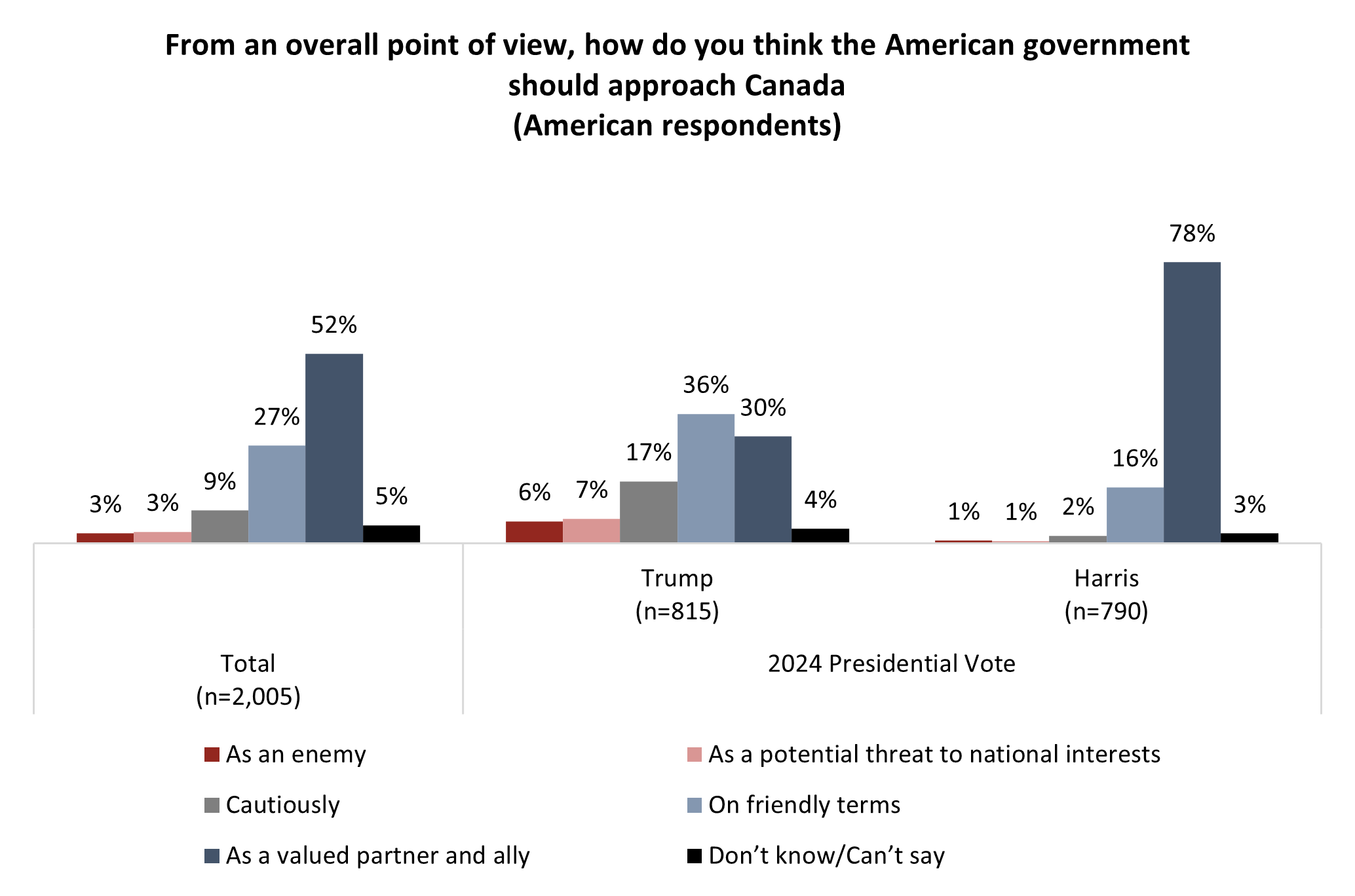
When asked how the U.S. government should approach these countries, consensus hardens further. Eight-in-ten Americans say Canada should be treated on friendly terms or as a valued partner and ally, as do three-quarters when asked about the U.K. Even among Trump voters — who are more skeptical across most foreign policy questions — large majorities endorse close relationships with both countries.
China: a unifying concern, interpreted through partisan lenses
China stands apart as the country Americans view most negatively. Six-in-ten (61%) hold an unfavourable view overall, including nearly eight-in-ten among Americans aged 55 and older. Only 23 per cent say they see China favourably.
Here, partisan differences are stark. Seven-in-ten Trump voters view China unfavourably, compared to 59 per cent of Harris voters. When asked how the U.S. government should approach China, more than four-in-ten Americans (43%) say China should be treated as an enemy or potential threat — rising to 62 per cent among Trump voters, compared to 32 per cent of Harris voters. Younger Americans are notably less likely to adopt a hardline stance, with those under 35 twice as likely as seniors to see China as a potential partner or to express uncertainty.
Mexico and India: mixed views, widening partisan gaps
Opinions of Mexico are divided but lean positive overall. A slim majority of Americans (54%) hold a favourable view, while one-third (34%) say they view Mexico unfavourably. Harris voters are far more positive (78% favourable) than Trump voters (33%), who are also far more likely to see Mexico as a threat or enemy in diplomatic terms.
India occupies a middle ground in American opinion. More Americans view India favourably (44%) than unfavourably (30%), though uncertainty remains high. Harris voters again express warmer views, while Trump voters are more divided. Younger Americans tend to be more optimistic about India’s role globally, while older cohorts express greater skepticism.
Views of leadership mirror geopolitical divides
These same partisan fault lines extend to opinions of political and business leaders.
U.S. President Donald Trump remains a polarizing figure. Overall, Americans are evenly split, with 44 per cent holding a favourable view and 52 per cent unfavourable. Among Trump voters, favourability reaches an overwhelming 92 per cent, while just six per cent view him unfavourably. Among Harris voters, the pattern is reversed: 96 per cent express an unfavourable view.
Tesla CEO Elon Musk also divides Americans, though less rigidly. Overall, more Americans view Musk unfavourably (57%) than favourably (36%). Trump voters are far more likely to see Musk positively (78%), while Harris voters are overwhelmingly negative (96%). Younger men are the most likely demographic group to hold favourable views of Musk, while older women are the most critical.
Bottom line
Americans in 2025 largely agree on who their closest allies are and which global powers pose the greatest concern. But beneath that surface consensus lies a deeper divide: partisan identity increasingly shapes not just domestic politics, but how Americans interpret the world beyond their borders — and the figures they associate with power, influence, and leadership.
MEDIA CONTACT:
Shachi Kurl, President: 604.908.1693 shachi.kurl@angusreid.us @shachikurl
Dave Korzinski, Research Director: 250.899.0821 dave.korzinski@angusreid.us
For detailed results by age, gender, region, education, and other demographics, click here.